Proxy provider security review: 6 checks before you buy
A proxy provider security review for privacy-first buyers: terms, abuse handling, credentials, measured traffic, logs, IP sourcing and what certificates prove.
Quick summary · TL;DR
- A proxy provider security review scores what a buyer can verify. Published terms and banned uses, abuse handling, credential handling, measured traffic behaviour, refund terms and the data the privacy policy says is logged.
- Privacy-first buying is a legitimate choice. Practice on identity checks varies, and a buyer who will not upload documents can still review a vendor on its terms, its policies and its gateway.
- A proxy sees connection metadata; verified TLS keeps the content out of reach. Over a CONNECT tunnel with certificate checks on, the vendor sees client IP, hostname, timing and volume, but not page content or cookies.
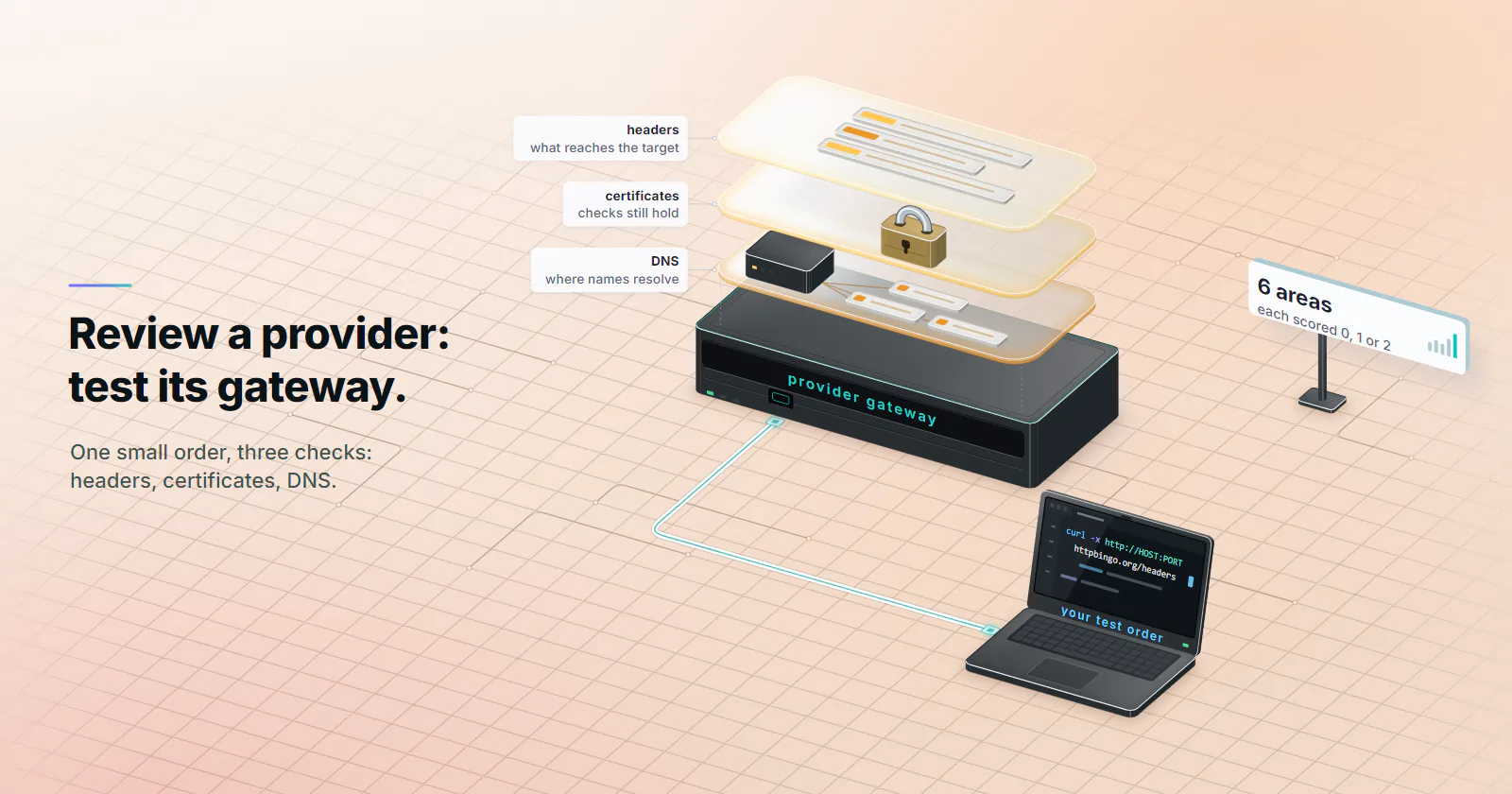
- Test the gateway on a small order. One small order and three curl commands show which headers reach the target, whether certificate checks hold and where DNS resolves.
A proxy provider security review checks what a vendor commits to in writing and what its gateway does to a request, before any production traffic moves. Six areas carry the score: published terms and banned uses, abuse handling, credential handling, measured traffic behaviour, refund terms, and what is logged. Each one can be checked from public pages and one small test order.
Three more questions frame the score without being scored: how residential exits joined the pool, what any certificate covers, and who controls the data the buyer collects. They shape how much weight each answer carries.
In January 2026 Google disrupted what it called the largest residential proxy network it had found, and in July, in coordination with the FBI, it acted against a second network it describes as a botnet (Google GTIG, 2026-07-02). A proxy vendor in the network path of production traffic deserves the same review as any other vendor there.
What a proxy provider security review covers
A proxy vendor sits in the path of every request a scraper, ad-verification job or QA suite sends. It sees the client’s IP, the hostnames it reaches, and when and how much. So the review has two halves: what the vendor commits to (terms, abuse handling, refunds, logging) and what its gateway does to a request (credentials, headers, DNS, TLS).
| Area | Strong answer | Weak answer |
|---|---|---|
| Terms and banned uses | Named bans and a stated rule for a breach | “No illegal use” and nothing more |
| Abuse handling | A published abuse address and a stated action | A generic support form |
| Credentials | A username and password issued per order | One login shared across customers |
| Traffic behaviour | Headers and DNS measured on the gateway, method published | “Fully anonymous” with no test behind it |
| Refund terms | A written money-back window and a rule for a degraded pool | Refund promises made only in chat |
| Logging | Named fields, stated purposes, limited staff access | “No logs” with no policy behind it |
Answers in writing count. Vague answers count as no.
Customer screening and acceptable use
Read the acceptable-use policy before anything else. A useful proxy acceptable use policy names the banned activities (fraud, credential stuffing, spam, malware, fake accounts and fake engagement) and says what happens on a breach: suspension, termination, and whether a refund survives it. A policy that says only “no illegal use” gives the vendor nothing to enforce.
The terms matter to the buyer because a pool’s addresses are shared, in time or in reputation, with every other customer. Named bans are the rules a vendor can actually hold those customers to.
Customer screening is where practice differs most. Some providers check documents before any access, others reserve the right to verify identity and use it when a risk signal appears. Some buyers will not upload a passport to a proxy vendor to watch prices, and that is a legitimate privacy choice. This review leaves identity paperwork out of the score on purpose: the bans, the abuse contact and the breach rule show how a vendor keeps its pool clean, and all three are in writing.
IP sourcing and consent evidence
For residential and mobile pools, ask how a device came to carry other people’s traffic. Three questions cover it: how the device joined, what its owner agreed to, and how the owner leaves.
The question got sharper in 2026. Google’s January report on the largest residential network it disrupted found apps that joined devices to the network as exits without clear disclosure to the user (Google GTIG, 2026-01-28). The FBI warned in March that free VPN apps and apps that pay for bandwidth can enrol devices without clear consent (FBI IC3 PSA, 2026-03-12).
A strong answer is plain and written: the owner opted in and can opt out. A pool size, or “ethically sourced” on a badge, answers a different question. Sourcing stays out of the six-area score because a buyer cannot test it from outside; it frames how much trust the other answers earn.
Abuse handling and legal requests
Ask where abuse reports go and what happens when one is credible. Look for a published address and a stated consequence, such as suspension of the account behind the traffic.
Then ask what the vendor discloses on a legal request. The useful answer says the vendor discloses only what the request lawfully requires.
Authentication and credential handling
Most proxy access runs on a username and password per order, per port or per IP. Ask how credentials are issued and whether any login is shared between customers. One login shared across customers means one leak exposes all of them, and abuse on it cannot be tied to one account.
On the buyer side, the main leak is the proxy URL itself. A string like http://USERNAME:PASSWORD@HOST:PORT ends up in shell history, CI logs and error reports. Keep the credentials in a secrets manager, inject them at runtime, watch usage for traffic nobody on the team sent (the clearest sign a credential has leaked), and percent-encode the login so a reserved character cannot break the URL:
import os
from urllib.parse import quote

import requests

user = quote(os.environ["PROXY_USER"], safe="")
password = quote(os.environ["PROXY_PASS"], safe="")
proxy = f"http://{user}:{password}@HOST:PORT"

r = requests.get("https://httpbingo.org/ip", proxies={"http": proxy, "https": proxy}, timeout=30)
print(r.json())
Traffic visibility and encryption you can measure
When a client sends HTTPS through an HTTP proxy, it opens a CONNECT tunnel and runs TLS end to end with the target (RFC 9110, 2022-06). With certificate verification on, the proxy cannot read page content, cookies or form fields. It still sees the client IP, the target hostname, connection times and data volume. SOCKS5 behaves the same way for TLS traffic. Running a client with verify=False or curl -k gives that protection away, and so does setup advice that tells the buyer to switch verification off.
Headers. A forwarding proxy on plain HTTP can announce itself with Via, or pass the client’s address in X-Forwarded-For or in Forwarded, the standard header RFC 7239 (June 2014) defined for it. Over a CONNECT tunnel to an https:// site the proxy only relays encrypted bytes, so it cannot add any of them.
DNS. Part of it is the buyer’s choice. With HTTP CONNECT or socks5h:// the proxy side looks up the hostname, while plain socks5:// makes the client resolve it, so the buyer’s own resolver learns every target.
All three can be measured on a small paid order. Use an echo endpoint that returns every header it receives, such as httpbingo.org, and run the first command once without the proxy as a baseline. The echo service’s own host adds headers too: httpbingo.org runs on Fly.io, which adds a Via entry for fly.io (such as 2 fly.io) and its own X-Forwarded-For entries to every request. Through the proxy, compare against that baseline. An extra Via, a Forwarded header or an extra X-Forwarded-For address over https:// means something in the path opened the tunnel, or your own client added it.
# Credentials from the environment; -U keeps them out of the proxy URL
# 1. Headers that reach the target (compare Via, Forwarded and X-Forwarded-For with a run without -x)
curl -s -x http://HOST:PORT -U "$PROXY_USER:$PROXY_PASS" https://httpbingo.org/headers

# 2. Certificate checks stay on: this must fail with exit code 60, not pass
curl -s -x http://HOST:PORT -U "$PROXY_USER:$PROXY_PASS" https://expired.badssl.com/ ; echo "exit code $?"

# 3. Which resolver looked up a fresh name over socks5h
curl -sL -x socks5h://HOST:PORT -U "$PROXY_USER:$PROXY_PASS" https://edns.ip-api.com/json
Exit code 60 on the second command is the pass: the client still rejects a bad certificate when the request goes through the proxy. Any other non-zero code, most often 56 or 7, means the request through the proxy did not complete (credentials, connection or a refused tunnel), so fix that and rerun. A success means something is accepting certificates on the client’s behalf, such as a verification-off setting or a vendor root certificate added to the trust store. The third command names the resolver that did the lookup; on curl 8.16 or later, add -v --trace-config all to see the “(remotely resolved)” line as well.
Logging: what the privacy policy states
Almost every proxy provider logs. Every provider that bills by the gigabyte has to count bytes per customer, and most keep connection records for abuse handling. Check any “no logs” line against the privacy policy; what proxy providers log walks through the usual fields.
So ask the narrower questions: which fields are logged, for what purpose, the basis for keeping them, and who inside the company can read them. Each one should have an answer in the privacy policy, along with whether the data is sold or used for advertising.
Contract terms as written
Read the refund section of the terms, not a sales page. Two clauses decide it: the money-back window on a new purchase, with any usage limit attached, and what the vendor does when a pool degrades below what was paid for. Both belong in writing, specific enough that a buyer knows what to ask for and when. Ask too how outages are communicated: where planned maintenance is announced, and whether the vendor says what happened after the service goes down.
Read the liability and governing-law clauses too, so the team knows what the contract covers before legal asks. Then settle the data roles. The vendor’s account and connection records are its own data; whatever the buyer collects through the proxies is the buyer’s, and the buyer answers for its lawful basis. Whether a vendor also acts as a processor under GDPR depends on the contract, so that is a question for the buyer’s counsel, not for a checklist. The privacy policy should list who receives data, at least by category, and why.
Certifications and independent assurance
Vendor questionnaires usually ask for certificates, so read what each one covers. ISO/IEC 27001 certifies that an information security management system meets the standard for a stated scope, and the scope can be narrow. A SOC 2 report is an auditor’s opinion on a set of controls, either at a point in time (Type 1) or over a period (Type 2). Both are worth reading when a vendor offers them, scope page first.
Neither says how a residential exit joined the pool, which headers reach the target, or whether certificate checks hold through the gateway. That is why this review scores the gateway and the written terms, and treats a certificate as context for the vendor’s own systems.
Scoring the answers
Score each of the six areas 0, 1 or 2: 0 for no answer or a vague one, 1 for a clear written answer, and 2 for a written answer the team has also checked, such as a policy clause it read or a result from the paid order. The traffic area is the easiest to score 2 on, because the three commands above produce the evidence.
The red flags are the weak column of the table: bans limited to “illegal use”, a no-logs claim the policy contradicts, shared logins, advice to disable certificate checks, no written answer on how residential devices joined, and refund promises that live only in chat.
How proxymint answers
The same six areas apply to proxymint, and the terms, the privacy policy and the Lab page below carry the answers.
- Terms and banned uses. The terms of service ban fraud, credential stuffing, spam, malware, fake accounts and fake engagement, and more. Accounts that break them can be suspended without notice where the risk requires it, with no refund on a termination for breach. Identity verification is a right the terms reserve, used when risk calls for it, and sanctioned or denied parties are excluded from the service.
- Abuse handling. Reports go to abuse@proxymint.com, and proxymint acts on credible reports. On a legal request, the privacy policy says proxymint discloses only what the request lawfully requires.
- Credentials. Every tier authenticates with a username and password issued for the order, never shared between customers, with HTTP and SOCKS5 included.
- Traffic behaviour. proxymint’s own measurement on the residential and mobile gateway found no Via and no Forwarded header at the target, and names resolved on the proxy side over HTTP CONNECT and
socks5h://, in the proxy leak test results of proxymint Lab #1 (measured 2026-09-28). - Refunds. The terms set a 7-day money-back guarantee on a first purchase, with a usage limit, and a refund or credit when a pool degrades below what was paid for. The terms also commit to announcing planned maintenance ahead of time and saying what happened when the service goes down, and the status page checks the API and dashboard from the reader’s own browser.
- Logging. The privacy policy lists the connection metadata logged and why, limits access to the people who run the service, and states that the data is not sold or used to build advertising profiles.
- Data roles. The privacy policy says the customer controls what it collects through the proxies, and lists by category who receives proxymint’s data and why.
- Sourcing. Residential exits come from device owners who opted in and can opt out.
A security team that needs more than the published pages can send the questions above through the contact page.
What to do with the review answers
If the job touches signed-in accounts or a regulated team, run the full proxy provider security review and get every answer in writing before a test order. If the job is public-data collection with no credentials in the traffic, the terms, traffic and logging areas carry most of the weight, because they decide who shares the pool and who can see the destinations.
If a fixed address matters more than pool size, static ISP proxies narrow the review: each IP is an ISP-registered address assigned to your order for the whole billing term, so the buyer knows which addresses carry its traffic. Rotating residential fits jobs that need many addresses, and how its exits work is laid out in what a residential proxy is.
If the review is of a vendor already in use, switching proxy providers covers moving jobs across without downtime.
Frequently asked questions
Six scored areas a buyer can check: the acceptable-use terms and the uses they ban, how abuse reports are handled, how access credentials are issued, what the gateway does to a request (headers, DNS and TLS), the refund terms as written, and what the privacy policy says is logged. Around them sit three questions that frame the score: how residential exits joined the pool, what any certificate covers, and who controls the data the buyer collects. Answers should be in writing, and a vague answer counts as a no.
Ask in writing how devices joined the pool, what the owner agreed to and how the owner leaves. A plain answer that names opt-in consent and an opt-out is the useful one. A pool size, or the word "ethical" on its own, answers a different question. Google's January 2026 report found apps that enrolled devices as exits without clear disclosure to the user, which is why the consent answer matters.
Almost all of them log connection metadata, because per-GB billing needs byte counts per customer, and most also keep connection records for abuse handling. The useful questions are which fields are logged, why, and who can read them, and the privacy policy should answer all three. A no-logs claim should be checked against that policy.
Not the content, if the client verifies certificates. HTTPS through an HTTP or SOCKS5 proxy runs TLS end to end between the client and the target, so the proxy cannot read pages, cookies or form fields. It still sees the client IP, the target hostname, connection times and data volume, and a client that disables certificate checks loses that protection.
Practice varies. Some providers check documents before any access, others verify when a risk signal appears, and every reputable one bans fraud, credential stuffing and spam in its terms. A buyer who prefers not to share identity documents is making a legitimate privacy choice, so read the terms for the bans, the abuse contact and what happens on a breach rather than scoring paperwork.
None is required to sell proxies. ISO/IEC 27001 certifies an information security management system for a stated scope, and a SOC 2 report is an auditor's opinion on controls over a period. Both are worth reading when offered, scope page first, because neither says how a residential exit joined the pool or what the gateway does to a request.
Terms that ban only "illegal use", a no-logs claim the privacy policy contradicts, logins shared between customers, setup advice that turns certificate verification off, no written answer on how residential devices joined, and refund promises that live only in a sales chat. Each one can be checked from public pages or a small test order.
Researched and drafted with AI tools, then checked against our publishing rules before it went live: 6 outside links, 11 links to other proxymint pages, no prices and a fact-check pass against our product records. How we write.