Mobile proxies in 2026: what platforms actually check
Mobile proxy detection runs in layers: carrier ASN, CGNAT, TCP stack, TLS and behaviour. What a real carrier pool changes, what the client owns, how to check.
Quick summary · TL;DR
- Detection is layered. ASN classification, TLS fingerprints (
JA3/JA4), TCP/IP stack, DNS-ASN coherence, and CGNAT shared-IP all score together. Fake mobile pools stack mismatches and lose on the first connection. - CGNAT is the trust signal you cannot fake. One carrier IPv4 can represent hundreds or even thousands of users, so platforms cannot block it without collateral damage. Datacenter pools cannot reproduce that.
- A carrier IP fixes the IP layer only. The TLS fingerprint, HTTP/2 settings, headers and behaviour belong to the client. A script on a real carrier address still fingerprints as a script.
- Mobile fits a narrow set of targets. App-first social platforms, mobile ad verification and app QA call for a mobile origin. Commerce, classifieds, and travel are usually residential or datacenter territory.
- Three questions catch fake mobile pools. WHOIS the sample IP for a carrier ASN, ask whether egress runs on a mobile carrier network or a virtual setup, and confirm rotation cadence in minutes, not in marketing words.
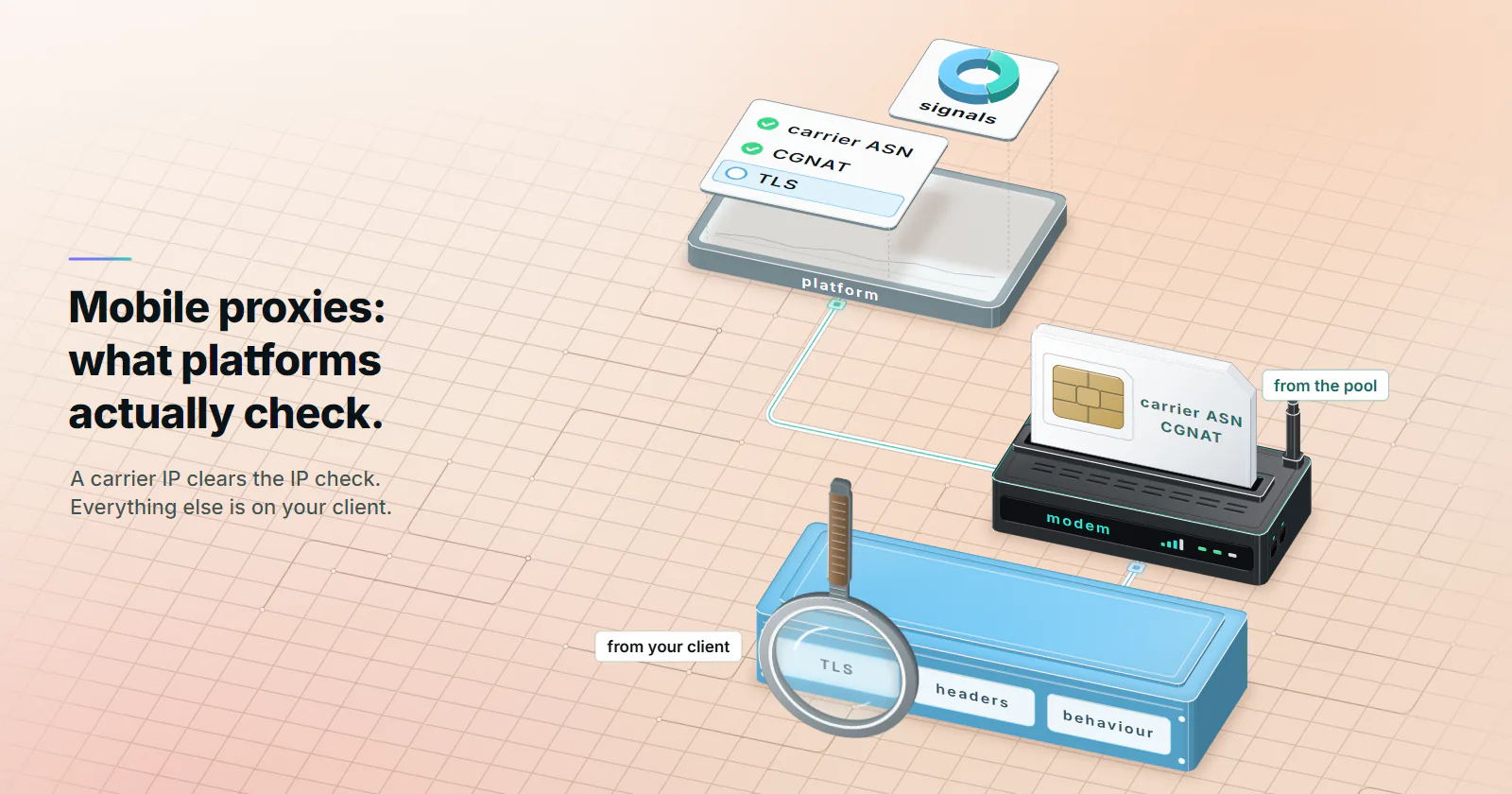
Mobile proxy detection works in layers. A platform first checks whether the IP sits on a carrier ASN behind CGNAT, which datacenter ranges relabelled as mobile fail at once. A real carrier IP only clears that first layer. The TLS fingerprint, the TCP stack, headers and behaviour are scored too, and the client, not the pool, controls most of them.
Carrier 4G proxies and 5G proxies egress from mobile carrier networks (T-Mobile, Verizon, Vodafone, Orange). A pool billed as mobile that dies on the first login check is often a datacenter range relabelled as mobile and sold at mobile prices, and ASN classification flags it before the page loads.
What “mobile proxies” actually means
A mobile proxy is a request egressing from a phone or modem on a carrier network, billed as cellular traffic, and often sharing a public IPv4 via CGNAT, where one address can represent hundreds or even thousands of users.
The carrier is the trust anchor. When a request leaves a T-Mobile US tower and arrives at Instagram, the source ASN is AS21928 (T-Mobile USA). Instagram’s risk model sees a carrier network. The same request leaving a Hetzner box in Frankfurt shows a hosting network, the class bot rules filter first.
Most cheap “mobile” pools skip the SIM and the tower entirely. The provider rents a datacenter range, relabels it mobile in the dashboard, and hopes the buyer never checks the ASN. Anti-bot vendors check the ASN within milliseconds. The pool fails on layer one, before any TLS fingerprinting even runs.
The detection stack platforms run today
Cloudflare and Akamai run most of the bot management a mobile proxy meets. Akamai’s Bot Manager documentation splits its checks into transparent detection (header signatures, out-of-order headers, browser version mismatches and dozens of other request anomalies), active detection (challenges run in the browser) and behavioural detection (movement patterns and other interaction details). Cloudflare added per-customer models in September 2025 that learn what normal traffic looks like on each site, alongside fingerprint heuristics built on HTTP/2 fingerprints and ClientHello extensions.
The TCP/IP layer uses tools like p0f to read TTL values, TCP window size, MSS, the order of TCP options, and the DF bit. A claimed iOS Safari ClientHello arriving with a Linux TCP stack is a mismatch that check can flag on the first packet.
TLS fingerprinting runs the JA3 and JA4 hashes against known browser baselines. Google’s security team announced in a September 13, 2024 post that Chrome 131 would switch its hybrid post-quantum key share from Kyber to ML-KEM (X25519MLKEM768, codepoint 0x11EC). So a ClientHello that claims a recent Chrome version without that key share is an easy mismatch to flag before any HTML is served. An HTTP client that copies a Chrome user agent but not its TLS stack carries exactly that mismatch. The proxy does not change it. A tunnelling proxy (HTTP CONNECT or SOCKS5) relays the client’s encrypted bytes, so the ClientHello the target fingerprints is the one the client sent, whatever IP it arrives from.
DNS-ASN coherence
The DNS resolver used during a session has to make sense with the egress IP. A T-Mobile US IPv4 resolving DNS through Cloudflare 1.1.1.1 in Frankfurt is a network incoherence that mobile proxy detection can flag. Real phones use the carrier’s recursive resolver, or a major public resolver in the same metro area. Where the lookup happens depends on the client too: through an HTTP proxy or with socks5h, the proxy side resolves the hostname; with plain socks5, the client resolves it locally and the resolver can sit in a different country from the exit.
Signals beyond the IP address
Mobile proxy detection does not stop at the address, because a carrier IP on its own cannot separate a real subscriber from a proxy. Fraud and anti-bot teams check whether the device and browser agree with each other, how fast a session moves, whether challenge outcomes and account history fit, and what the action is worth. A carrier IP changes none of those. A session that fires requests at machine-regular intervals from a real T-Mobile address still reads as automation.
That is also how defenders avoid hurting real subscribers. A carrier address that misbehaves gets a challenge, a rate limit on the session or account, or a closer look at the device, while the thousands of phones behind the same address keep working. Mobile exits do carry abuse, such as credential stuffing, fake accounts and click fraud, and proxymint’s terms ban all three. The same carrier exits also carry legitimate work such as ad verification and app QA, so the address alone settles nothing.
Why CGNAT is the trust signal
Carrier-grade NAT is the reason mobile sits at the top of the trust ladder, and it is the reason platforms cannot block mobile carrier ranges without collateral damage. Cloudflare’s CGNAT research (October 29, 2025) notes that a single IPv4 address behind CGNAT can represent hundreds or even thousands of users.
If Instagram blocks that IP, it also blocks thousands of legitimate users browsing on the train. A hard block is expensive, so the anti-bot stack leans on the next signal in the chain. That does not make the address a free pass. The same Cloudflare research found CGNAT IPs were rate limited three times more often than other addresses, which is the collateral damage it set out to reduce. The same study put the median bot rate at 4.8% on CGNAT addresses and 4.7% on other addresses. Sharing an IP neither hides bots nor makes an address suspect, so the score comes from the rest of the stack.
Fake mobile pools cannot fake this part. They sit on datacenter IPv4s where the only “users” sharing the IP are other scrapers from the same buyer. ASN classification flags the address as datacenter on the first request, and the request pays datacenter trust prices regardless of what the dashboard claims.
Carrier IP rotation cadence inside a real mobile pool is also part of the signal. Subscribers do not change public IPs every two seconds. A phone holds an IP for minutes or hours, then rotates when the device hands off between towers or the CGNAT pool reassigns. On proxymint, a sticky mobile session holds for as long as the device stays online, and timed rotation runs from 5 to 60 minutes, which tracks how long a real device might hold an IP. Carrier IP rotation that fires too aggressively makes pools look bot-shaped even when the ASN is real.
Where fake mobile proxies fail
Mobile proxy detection scores signals together. A detection stack tolerates a single mismatch, and fake mobile pools stack several on every connection.
The ASN is wrong (datacenter, not carrier). The TCP/IP stack is wrong (Linux server defaults, not a phone or modem). The DNS resolver sits in the wrong country for the exit. Then come the client-side misses that no pool fixes, real or fake: a TLS fingerprint that does not match the claimed browser, an HTTP/2 SETTINGS frame that gives away the library, a WebRTC leak that exposes the client’s own IP, canvas hashes too clean and AudioContext too consistent across “different” devices.
Each of those is a small score bump. Stacked, they can cross a blocking threshold on the first request.
Behavioural detection adds another layer. Akamai’s behavioural checks read movement patterns and other interaction details, so perfectly linear mouse paths and zero keyboard events score as bot whatever IP the request came from. No proxy changes that part, and a fake mobile pool has already lost the IP layer before it starts.
What carrier 4G and 5G pools do differently
A carrier 4G proxy or 5G proxy egresses through a SIM card in a phone or modem on a carrier network. The ASN is the carrier’s (AS21928, AS6167, AS3320, AS3209). The CGNAT pool is real. The TCP/IP fingerprint is the egress device’s own, often a phone or a hardware modem running an Android stack. When the device itself resolves DNS, the lookup goes through the carrier’s resolver; when a gateway resolves it, the resolver should at least answer from the exit’s country.
5G proxies add one more wrinkle: IPv6. Carriers are migrating to IPv6-only cores with 464XLAT (RFC 6877, April 2013), which keeps the IPv4 path CGNAT-shared and high-trust but exposes a near-unique per-device IPv6 prefix on the native v6 path. Pools that force IPv4 egress preserve the trust signal; pools that leak the v6 prefix can hand the detection stack a unique device identifier without realising it.
What the pool controls, and what it doesn’t
A real carrier pool controls four signals: the ASN, the CGNAT sharing, the exit device’s TCP/IP stack and the rotation cadence. The client controls the rest: the TLS ClientHello and its JA3/JA4 hash, the HTTP/2 SETTINGS frame, headers, the browser fingerprint, client-side DNS and behaviour. Buying mobile fixes the first list and does nothing for the second.
There is one mismatch a real pool can create on its own. The exit presents its device’s TCP stack, so a desktop or iOS browser claim riding on an Android or modem stack is an inconsistency mobile proxy detection can score. The honest fix is a client whose claims match the network it runs on, not a different proxy.
What a carrier pool runs on
A carrier pool runs on carrier data plans, phones or modems and metered cellular links, not on server bandwidth bought in bulk. That is why the ASN check matters: a “mobile” pool whose exits announce from a hosting network is usually not what the label says.
Mobile proxies vs residential proxies
Mobile proxies vs residential proxies is a target-fit question, and the side-by-side of mobile vs residential proxies turns on what the target checks. Residential IPs come from home broadband connections on consumer ISP ASNs and work cleanly against e-commerce sites, classifieds, travel aggregators and most marketing intelligence work; the mechanism is covered in what a residential proxy is and how it works.
Mobile proxies fit a narrower set of jobs: app-first social platforms and account workflows that check for a mobile origin, mobile ad verification in a carrier user’s market, and app QA against real carrier routing. Those targets weight carrier ASN and CGNAT shared-IP signals heavily because their legitimate audience is heavily mobile. A residential IP on a Comcast home connection looks fine on Amazon and can look out of place on an app whose users are almost all on cellular. For desk-based account work, such as an agency running client accounts through the platform’s own business tools, a fixed address matters more than a carrier one, and a static ISP proxy fits better.
The decision comes down to four questions. What is the target? What action runs on it? What is the per-account cost of a ban? What is the bandwidth volume per session? Light scraping at high volume on commerce sites is residential territory. App-first platforms at lower volume per IP tilt the other way.
Datacenter proxies still have a place on lighter targets where speed and volume matter more than ASN trust. ISP proxies (ISP-registered addresses on datacenter servers) sit between residential and datacenter for persistent-identity work, and the session-model split that decides between them is covered in ISP proxies vs rotating residential. The four tiers side by side are in types of proxies.
What to ask before buying mobile
Three questions separate honest mobile pools from datacenter pools wearing mobile labels. Ask the provider for a sample IP, run a WHOIS lookup, and confirm the ASN is a carrier (T-Mobile, Verizon, AT&T, Vodafone, Orange, Three, EE) and not a datacenter operator. Ask whether the egress runs on a mobile carrier network, or on a “mobile-grade” virtual setup. Ask about carrier IP rotation cadence and sticky session limits in minutes, not in marketing words.
The ASN check takes two commands. Send one request through the proxy to see the exit IP, then look up who announces it:
# 1. The exit IP the target sees
curl -s -x http://USERNAME:PASSWORD@HOST:PORT https://api.ipify.org
# 2. Who announces that IP (replace the example address with the output above)
whois -h whois.cymru.com " -v 203.0.113.10"
The AS name should be a mobile operator, not a hosting company. Read the owner, not a checker’s “mobile” or “datacenter” label: IP-intelligence databases tag ranges on their own schedules and can disagree about the same address. Repeat it 20 times on per-request rotation and the same check shows how many distinct addresses and networks the pool really hands out.
If the answers are vague, the pool is probably datacenter. A provider running exits on mobile carrier networks can answer all three without hedging, because the answers are operational facts about its stack.
One more question is where the devices come from. Your Phone is My Proxy (NDSS 2021) found four providers offering mobile proxy SDKs to app developers, and 1,701 Android APKs from 963 apps carrying them, with at least 300 million installs. The consent texts users saw were confusing, and one SDK relayed traffic without showing any notification. Ask how devices joined the pool and whether their owners can opt out.
If the target is an app-first platform that checks for a mobile origin, mobile is the tier built for it, and the rest of the stack is still the client’s job. If the job is price monitoring on a commerce site, the target does not ask for a carrier origin, and residential or datacenter proxies are built for that workload. proxymint’s mobile proxies run on mobile carrier networks, with exits classified as cellular by MaxMind, for the jobs that do.
Frequently asked questions
Yes. A carrier ASN and CGNAT make a hard block costly, not impossible. Platforms still score the TLS fingerprint, the exit device's TCP stack, headers, session speed and behaviour, and a browser claim that does not match the exit's TCP stack is its own mismatch. Cloudflare's October 2025 CGNAT research found a median bot rate of 4.8% on CGNAT addresses against 4.7% on others, so the address alone decides little.
No. A tunnelling proxy (HTTP CONNECT or SOCKS5) relays the client's encrypted connection, so the target fingerprints the ClientHello the client sent, JA3 and JA4 included. A Python HTTP client on a real carrier IP still looks like a Python HTTP client. Only the client changes its TLS fingerprint.
ASN classification flags datacenter IPs in milliseconds. TLS fingerprints reveal the real client stack. TCP/IP fingerprints expose Linux servers claiming to be iOS devices. DNS-ASN coherence catches a T-Mobile IPv4 resolving through a Frankfurt resolver. Each mismatch is a small score bump. Stacked, they can cross the bot threshold on the first request.
Carrier-grade NAT shares a single public IPv4 across hundreds or even thousands of users. Platforms cannot block CGNAT IPs without blocking real customers, so they rate limit and score the rest of the request instead. Fake mobile pools sit on datacenter IPv4s that are not CGNAT-shared, which gives platforms a clean signal to block.
On the IPv4 path, both stay CGNAT-shared and high-trust. On native IPv6, 5G can leak a near-unique per-device prefix that identifies sessions across requests. Pools that force IPv4 egress preserve the trust signal. Pools that pass IPv6 through can hand the detection stack a stable identifier without realising it.
Ask for a sample IP, run WHOIS, and confirm the ASN belongs to a carrier (T-Mobile, Verizon, AT&T, Vodafone, Orange, EE). Ask whether the egress runs on a mobile carrier network or a "mobile-grade" virtual setup. Ask carrier IP rotation cadence in minutes, not in marketing words. Vague answers usually mean datacenter.
Researched and drafted with AI tools, then checked against our publishing rules before it went live: 6 outside links, 13 links to other proxymint pages and no prices. How we write.