4G vs 5G proxies: what the generation actually changes
4G proxies and 5G proxies clear the same trust checks. The generation changes throughput and latency; the carrier address sets the trust score.
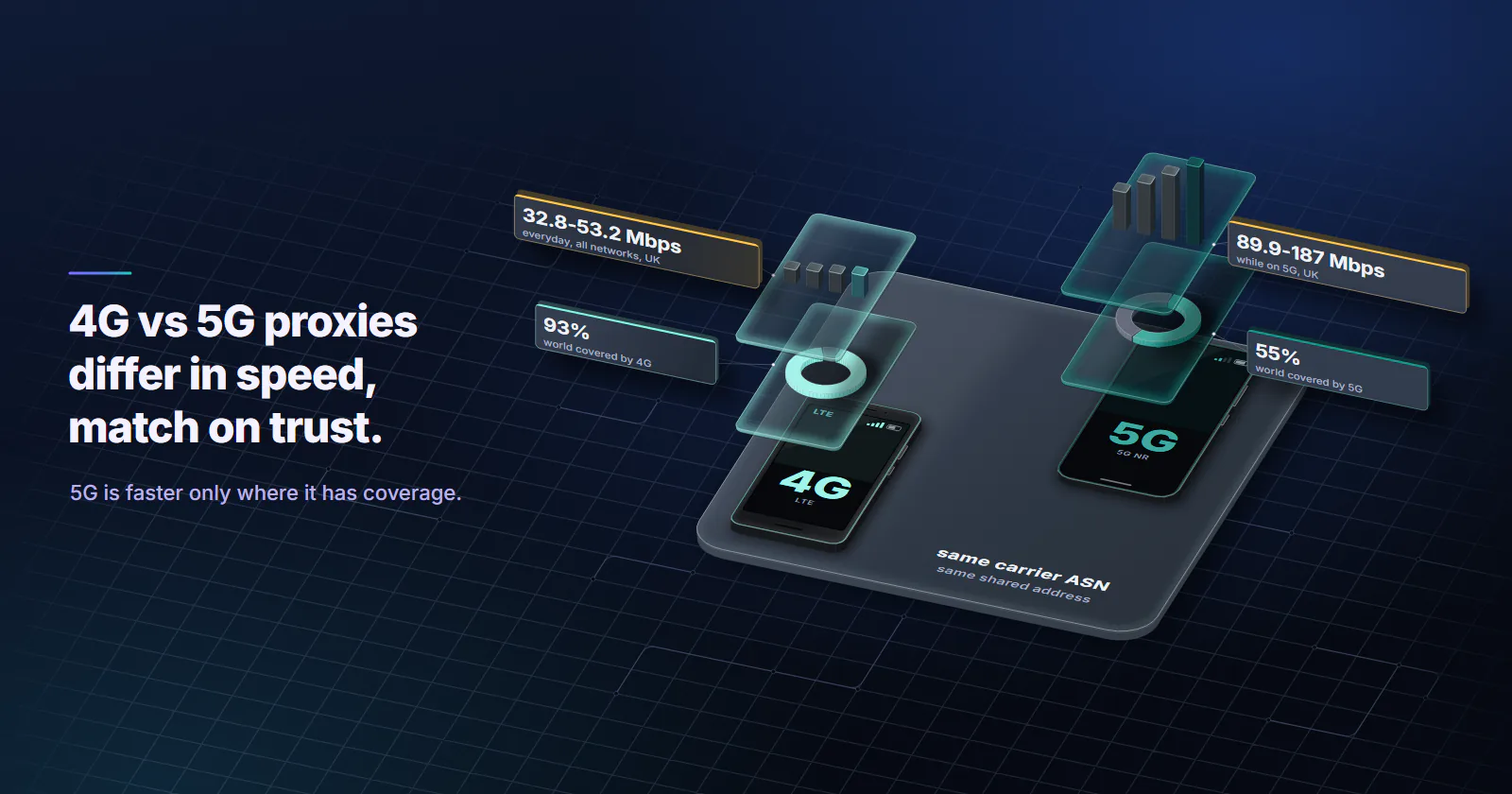
Quick summary · TL;DR
- The generation decides speed; the carrier decides trust. Anti-bot systems score the carrier ASN and the shared carrier address. Neither field records whether the handset attached over LTE or 5G NR.
- 4G proxies are the default for most jobs. Request-heavy work is bound by the target's rate limits and your own concurrency, not by radio throughput. The extra bandwidth sits idle while you pay for it.
- 5G proxies earn their price on payload. Media pulls, video, and large responses are where the throughput difference becomes real money rather than a spec-sheet number.
- Ask what the pool is, not what it is called. A "5G" label on a hosting ASN is worth less than a plain 4G pool on a real carrier, because the ASN is the field that gets scored first.
- A 5G label is not time on 5G. In Opensignal's UK data for late 2025, 5G phones on 5G plans had their data carried over 5G only 9.9% to 26.5% of the time. A pool sold as 5G inherits the same fallback to LTE.
4G vs 5G proxies differ in speed and match on trust. Both exit on the same mobile carrier addresses behind carrier-grade NAT, and the website on the other end cannot tell which radio carried the request. 5G adds throughput and cuts latency where coverage is real, which pays off for payload-heavy work. For request-bound jobs, 4G proxies clear the same checks for less.
Providers price 5G above 4G and let the number imply the rest. The implication is that a newer radio buys a better proxy. It buys a faster one, which is a different claim, and only worth paying for when speed is the thing standing in your way. For most jobs it is not, which is why 4G proxies remain the sensible default long after the marketing moved on.
What 4G proxies and 5G proxies actually change
What each one is. A 4G proxy routes traffic through a phone or modem whose SIM is attached to a carrier’s LTE network. A 5G proxy does the same over 5G NR. Either way the request leaves the carrier’s core on a public address the carrier owns, and that address is all the target sees of the connection. What are mobile proxies covers the product as a whole.
A mobile proxy earns its trust from two facts about the address it exits on. The address is announced by a mobile carrier’s Autonomous System Number, and it is shared among many of that carrier’s subscribers behind carrier-grade NAT, whose operator rules the IETF set out in RFC 6888 in 2013. Those are the fields an anti-bot system reads, and the mechanics behind both are covered in proxymint’s guide to CGNAT for proxy buyers.
Neither field knows anything about the radio. The generation describes how the handset talks to the tower, a leg of the path that ends before the traffic reaches the carrier’s network core and long before it reaches the site you are requesting. By the time a packet arrives at the target, the evidence of whether it started on LTE or 5G NR is gone.
The browser cannot report it either. The one web API that exposes a
network class, effectiveType in the Network Information API, returns at most
“4g” and has no “5g” value. It is derived from round trip time and downlink
measured on the machine running the browser, not from the radio at the proxy
exit
(MDN, updated 2024-04-01).
Network slicing does not change it. 3GPP defines a network slice as “a logical network that provides specific network capabilities and network characteristics” (3GPP, 2023-07-10), a partition inside the carrier’s own network. Traffic still leaves through the carrier’s core on the same public address space, so the target reads the same ASN and the same shared address.
So the trust score is identical. 4G proxies and 5G proxies on the same carrier present the same ASN, the same shared address space, and the same behavioural signals. The wider detection stack that acts on those signals is broken down in what platforms actually check on mobile proxies.
What does differ is throughput and latency, which matters for a narrower set of jobs than the pricing implies.
4G vs 5G proxies by the numbers
Speed claims on proxy pages rarely carry a source. Independent measurement does. Opensignal’s UK report for January 2026, covering 90 days from 1 October 2025, put average 5G download speed, measured only while a user was actively on 5G, at 89.9 to 187 Mbps across the four national operators. The everyday figure across all of each operator’s networks, 4G included, was 32.8 to 53.2 Mbps (Opensignal UK report, January 2026). On the same operator, that makes 5G about 1.7 to 3.7 times the everyday average.
Coverage is the other half. ITU estimates that 5G reached 55% of the world’s population in 2025 against 93% for 4G, with 84% 5G coverage in high-income countries and 4% in low-income ones. By region, Europe sat at 74%, Africa at 12% and the CIS at 8% (ITU Facts and Figures 2025, published 2025-10-15).
Read the speed figures as a ceiling for the radio. A proxy adds hops of its own.
Where the generation does earn its price
The 4G vs 5G proxies question turns on payload size.
Request-bound work sees no benefit. Scraping pages of text means many small responses. Each one finishes quickly on either generation, and total time is set by how many requests the target tolerates per minute and how much concurrency you run. Radio throughput is not the constraint, so raising it does nothing you can measure, and 4G proxies finish the job on the same clock.
Payload-bound work does. Pulling media, video, images at scale, or large documents means individual responses big enough for bandwidth to become the limit. Here the generation changes wall-clock time directly, and 5G proxies start paying for themselves.
Latency matters for interactive work. Lower round trip times help workflows that make many dependent sequential requests, where each one waits for the last. They help far less when requests run in parallel, because the waiting overlaps.
Four jobs, and which generation each one wants
These are the shapes of work that come up most often.
App-first account work. Accounts that live in a phone app, where a mobile origin matches how the account is normally used. A handful of sessions, small requests, long gaps between actions. Trust is everything and bandwidth is irrelevant, so 4G proxies on a well-regarded carrier are the correct purchase, and paying more buys nothing the platform can even perceive. Desk-based accounts that log in from one office are a better fit for static ISP proxies than for any mobile generation.
Price and catalogue monitoring. Thousands of small requests against a protected target. The binding constraint is the target’s rate limiter, not the radio, and most of these targets do not check for a carrier origin: rotating residential clears them. Where a target does check for a mobile origin, 4G proxies fit, with the budget spent on rotation control rather than radio speed.
Media and asset collection. Images, video, large files pulled at volume. Every response is big enough that bandwidth governs how long the job takes. This is the case where 5G proxies convert their premium into finished work rather than a faster number on a test, with one condition: the target has to need a carrier origin at all. Hundreds of gigabytes from a target that does not check for one is a residential or datacenter job on either generation.
Real-time or interactive sessions. Anything where a person or a process waits on each response in sequence. Latency dominates, so the lower round trip times of 5G proxies help, though only if the target’s own response time is not already the larger share of the wait.
Trust decides whether the request succeeds at all; the generation only decides how quickly a successful request finishes.
Fallback to LTE, and how to check for it
This is the practical risk in any 4G vs 5G proxies decision, and it is invisible from outside.
A 5G-capable device does not stay on 5G. When coverage is weak or the cell is congested, it falls back to LTE, and nothing in the proxy connection reports which radio carried your request. A pool sold as 5G can spend most of its working hours attached to 4G, and the invoice does not change.
The gap is measurable even in a mature market. In Opensignal’s UK data for the last quarter of 2025, people with a 5G phone and a 5G plan detected a 5G signal 29.6% to 77.4% of the time, depending on the operator. Their data was actually carried over 5G only 9.9% to 26.5% of the time (Opensignal UK report, January 2026). Those are phones in pockets, not fixed modems, so a stationary modem in a well-covered city can do better. It can also do worse, and only a measurement tells you which.
The dependence on LTE is built into how 5G arrived. 3GPP’s Release 15 delivered the first “non-standalone” 5G radio specifications in late 2017, a new radio integrated into existing LTE networks, before standalone 5G with its own core followed in 2018. Many networks still run that way, so a 5G connection often leans on an LTE anchor even when it is working as advertised.
How to check. Ask for throughput samples taken during your working hours, across the specific geography you need, rather than a peak figure. Better, run your own representative job against a trial and compare the measured result to the same job on a 4G pool. If the difference is inside noise, you are being billed for a capability the network is not delivering.
What to buy on instead
These matter more than the generation.
The carrier ASN. This is the field scored first, so it decides whether the address is trusted at all. A real operator name that survives a WHOIS lookup is worth more than any radio specification, which is the same ASN reputation logic that governs every tier on the ladder.
How rotation works. Whether the address changes on a timer, on request, or at the carrier’s discretion determines how your sessions must be written. It affects success rates far more than bandwidth does.
Where DNS resolves. A target can compare the resolver that looked up its
hostname with the exit address. On proxymint’s mobile per-GB tier, HTTP CONNECT
and socks5h:// resolve names on the proxy side, and plain socks5:// leaves
the lookup to your own machine, which puts your resolver’s location next to a
carrier exit. Neither depends on the radio generation.
Price per unit of your actual work. Compare cost per successful request, or per gigabyte delivered, rather than headline rates. A cheaper pool that fails more often is not cheaper.
Geography, which quietly outranks generation. Coverage is uneven, and a carrier’s 5G footprint is far smaller than its LTE one in most countries: on the ITU figures above, 74% of Europe’s population had 5G coverage in 2025 but only 12% of Africa’s. If the region you need sits outside that footprint, 5G proxies there are 4G proxies with a premium attached, and the provider may not volunteer which cities are actually covered. Ask for the city list before the throughput figure, because a fast pool in the wrong country is not a pool you can use.
How proxymint bills 4G and 5G proxies
proxymint’s mobile proxies exit on carrier addresses that MaxMind classifies as cellular, and the rate is the same whichever radio carries the request: usage-based per GB, with the rate falling as the package grows and every band on the pricing page. The order sets country, region, city and rotation. The radio generation is not one of the controls, and there is no 5G surcharge, because the platform on the other end cannot see the generation, so it cannot be worth paying extra for trust.
On a per-GB meter, speed changes time, not cost. A 50 GB media pull is billed the same on either radio, since the meter counts bytes, not seconds. At a sustained 50 Mbps that is about 2 hours 13 minutes of raw transfer; at 150 Mbps, about 44 minutes. Those speeds are a scenario, not a measurement of the pool.
Buy the carrier, then the generation
Treat 4G vs 5G proxies as the second of two purchases made in order. First buy trust, which means the carrier and how its addresses are shared and rotated. Only then buy throughput, and only when a measurement of your own workload shows bandwidth is the constraint.
For most request-bound jobs that means 4G proxies on a good carrier, which is the better-understood default. For payload-heavy work the market premium on 5G proxies is defensible, provided the provider can show the throughput is real rather than a specification the network quietly falls back from.
If you are still choosing a tier rather than a generation, the question ahead of this one is whether you need carrier addresses at all. Residential often clears the same targets when they do not check for a carrier origin, and that comparison is laid out in what a residential proxy is. The full ladder is in types of proxies. The rest of proxymint’s tier comparisons live on the blog.
Frequently asked questions
No. Detection systems classify the IP address by the Autonomous System Number that announces it and by the behaviour of the traffic. The radio generation between the handset and the tower is not visible to the website being reached, so it cannot factor into the score.
Throughput and latency. 5G offers higher peak bandwidth and lower round trip times under good conditions. Everything that determines whether a request is trusted, meaning the carrier ASN, the shared carrier address, and the session behaviour, is identical between the two.
Only where 5G is actually carrying the traffic. In Opensignal's UK measurements for late 2025, active 5G connections averaged 89.9 to 187 Mbps against 32.8 to 53.2 Mbps for everyday mobile use, yet 5G phones spent only 9.9% to 26.5% of their data time on 5G. Outside dense coverage the two perform alike, and a proxy adds hops of its own on either.
When your bottleneck is payload size rather than request count. Downloading media, video, or large documents at volume benefits directly. Scraping pages of text usually does not, because the target's rate limits bind long before the radio does.
Usually not in any way that matters. Carriers assign public addresses from the same pools regardless of the radio technology a subscriber attaches with, and both sit behind the same carrier-grade NAT infrastructure.
In practice yes, because 5G devices fall back to LTE whenever 5G coverage is weak, and nothing in the connection tells you which happened. Ask for a throughput sample taken during your own working hours rather than a peak figure from a coverage map.
Start on 4G, or on a pool that mixes 4G and 5G at one rate. Both clear the same trust checks, and 4G is sufficient for request-bound work. Pay extra for 5G only once a measurement, not a specification, shows throughput is the thing limiting you.
Researched and drafted with AI tools, then checked against our publishing rules before it went live: 6 outside links, 10 links to other proxymint pages, no prices and a fact-check pass against our product records. How we write.