TikTok proxies: regional research and brand accounts
TikTok proxies for brands and agencies: what TikTok's rules allow, how to see what each market is shown, and how to run accounts you own from one origin.
Quick summary · TL;DR
- A TikTok proxy is an exit IP in a chosen market. A browser profile or a phone reaches TikTok through it, so the check or the login comes from that country and city. It is not a modded app, and it does not change what TikTok's rules allow.
- Many TikTok jobs need no proxy. Creative Center shows trends by region for free, and Business Center gives agencies permission-based access to client accounts without shared passwords.
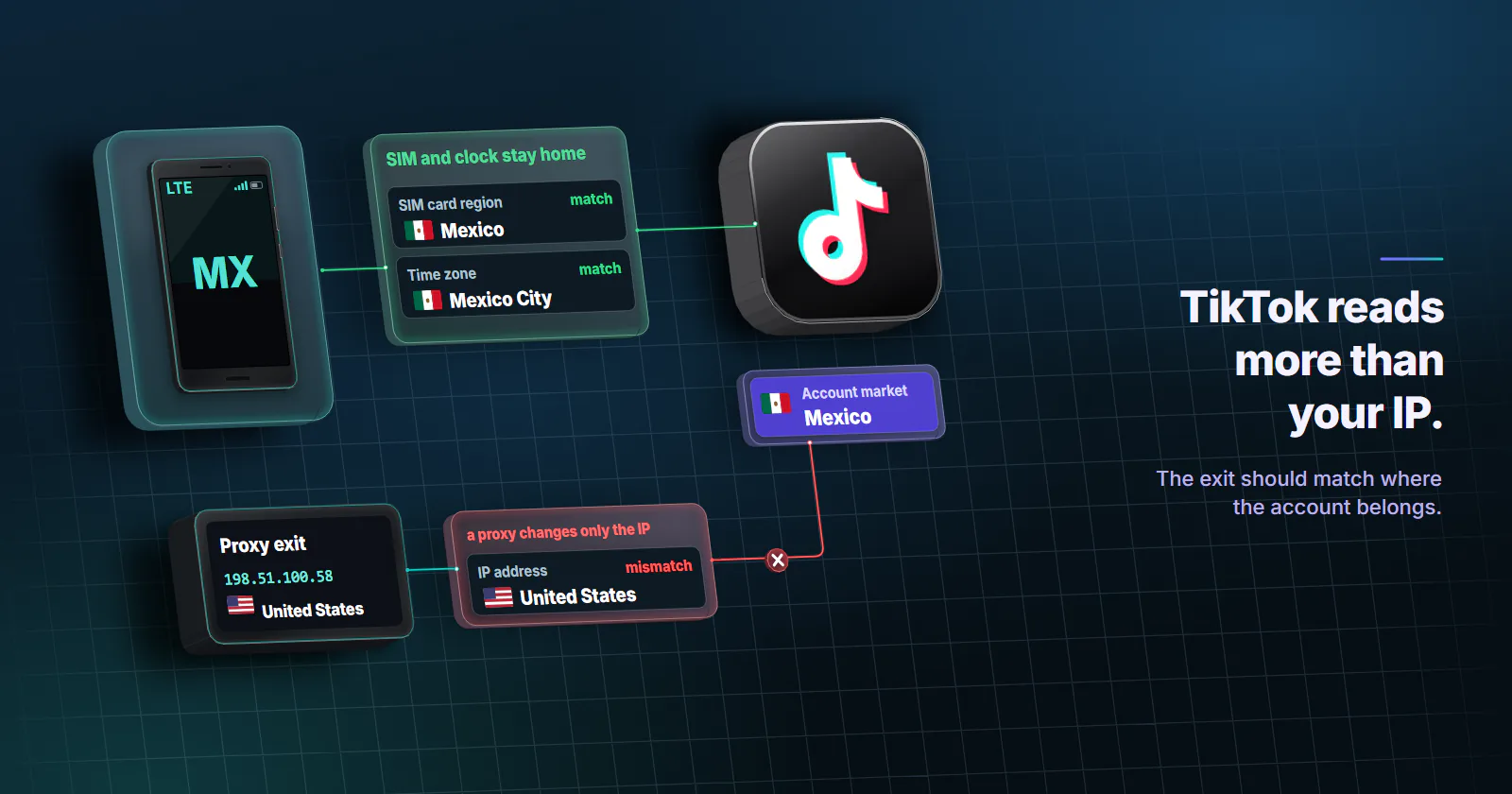
- TikTok reads location from more than the IP. Its privacy policy lists SIM card region, IP address and device settings, plus carrier and time zone. A proxy changes one input, so consistency with the account's real market is the goal.
- Pick the tier by job. Static ISP for desk logins that must hold for weeks, mobile for accounts run in the app on a phone, rotating residential for small logged-out web checks. Datacenter is built for collection and API work, not TikTok.
TikTok proxies give a browser profile or a phone an exit IP in a chosen market, so a brand or agency can see what that market is shown and keep its own accounts on one consistent login origin. They do not change what TikTok’s rules allow, and many jobs need no proxy at all: Creative Center and Business Center cover a lot of it for free.
The problem readers hit is usually one of two. A marketing team in Berlin wants to know what a search for its product returns in Mexico, or which ad creative runs there, and the feed on a Berlin laptop says nothing useful. Or a brand’s US account gets a login from an agency office in another country, and the account asks for verification.
Most pages ranking for tiktok proxies sell proxy volume and treat TikTok as something to get past. The rules below are quoted from TikTok’s own pages, and every recommendation stays inside them.
What TikTok proxies are
A proxy for TikTok is an intermediary IP address in a chosen country and city. One browser profile or one phone sends its TikTok traffic through it, so TikTok sees a connection from that market instead of the team’s office.
Three things share the name and are not the same:
- A TikTok proxy APK. A modified third-party build of the app, often surfaced in search next to “download”. It is not a network proxy, and it should not be installed.
- A VPN. A tunnel for the whole device, usually exiting from a hosting range that thousands of strangers share.
- A network proxy. One exit per profile or device, on a carrier, ISP or home network, which is what this guide means by TikTok proxies.
None of them is a way around TikTok’s rules. The rules apply to the account, whatever IP it arrives from.
Is a TikTok proxy APK safe?
No. A TikTok proxy APK is a modified build of the app from an unknown developer, and installing it hands that developer the phone and the account login. The safe setup is the official app or tiktok.com, with a network proxy set on the device or in one browser profile.
What TikTok’s rules allow
Community Guidelines. The Integrity and Authenticity section (TikTok Community Guidelines, version effective 24 September 2026) says you can have multiple accounts, for example for fan content or creative expression, “but not to deceive others or break the rules.” It prohibits “automation tools, scripts, or other tricks designed to bypass our systems” and the trade of services that artificially boost engagement. If an account is restricted or banned, “you may not create or use another account to get around it.” The same version adds that someone who seriously breaks the rules or tries to dodge enforcement may lose all their accounts, including associated accounts.
Terms of Service. Section 3.4 of the US Terms (TikTok Terms of Service, updated 15 July 2026) bars scraping, crawling or extracting data “using any automated system or software”, operating spam or impersonation accounts, and using another user’s account without authorization.
TikTok Shop. The US Seller Center rules for official accounts say each shop can be bound to one official account, and the account region must be the same as the shop region. From 1 July 2026, enterprise sellers linking a new official account must use an Organization Account (TikTok Shop US Academy, checked September 2026). Limits differ by market: TikTok Shop Singapore allows one verified corporate entity up to five seller accounts (TikTok Shop SG Academy, 10 May 2023). That figure is Singapore’s, not a global rule.
Legality and limits
Using a proxy is lawful in most places. The platform’s terms and local law govern what is done through it. Where a government blocks TikTok, as India has since June 2020, a proxy to reach it is out of scope here. This is general information, not legal advice.
What TikTok sees about location
TikTok’s privacy policy, under “Automatically Collected Information”, says it infers approximate location from “SIM card region, IP address, and device system settings” (TikTok Privacy Policy, updated 15 July 2026). The same section lists mobile carrier, time zone settings, network type and device identifiers.
A proxy changes one of those inputs. The rest stay where they were: the SIM still names its home country, the phone clock still says Berlin, the carrier is still the carrier.
So the honest answer to “does TikTok detect proxies” is that the IP is read next to everything else. A Mexican exit on a phone with a German SIM and a German clock is visible as a mismatch. The exit should match where the account or the check legitimately belongs. The Community Guidelines also say that when TikTok sees suspicious activity on an account, it may ask for verification such as an SMS or email code, a CAPTCHA or a login from a verified mobile device.
The network class matters too. Carrier addresses often sit behind shared NAT, which mobile vs residential proxies explains, while hosting ranges are labeled as servers by IP intelligence data. No source publishes how TikTok weighs each signal, and no success rate for any proxy type is honest to quote.
Run regional content checks
Markets differ for real reasons. Feeds and search are localized, TikTok Shop catalogs and ads are market-specific, and since January 2026 the US runs on its own track. The TikTok USDS Joint Venture said it will “retrain, test, and update the content recommendation algorithm on U.S. user data” and holds decision-making authority for trust and safety (TikTok Newsroom, 23 January 2026). So US and non-US results can be expected to drift apart.
Use TikTok’s own tools first
Creative Center. Trend discovery shows trending hashtags by industry, with regional popularity per hashtag (TikTok Ads Help Center, updated July 2026). For “what is trending in Germany this week”, it may be the whole answer, with no proxy.
Business Center. Agencies link client TikTok accounts and get either “Deliver ads” or the broader “Manage account” permission, which adds replying to comments and managing the profile (TikTok Ads Help Center, updated September 2026). That replaces password sharing.
Research API and Commercial Content Library. The Research API is for non-commercial, public-interest researchers in eligible regions (TikTok for Developers, checked September 2026), and the commercial content API currently covers ads shown in EU countries. Most brands will not qualify for the first, but both are the route for anything at volume.
See TikTok from another country
To see TikTok from another country, an exit in that market shows what a logged-out visitor there sees: web search results, hashtag pages, Shop listing visibility and the ad creative served in that market. It cannot show a personalized For You feed, which follows the account’s history, or change an account’s region, which comes from sign-up and device signals.
Region research checklist
- Write the question first: trend, search result, Shop listing or ad creative, and which markets.
- Check Creative Center for that market. Stop if it answers the question.
- Pick the exit: country and city from the locations online now. Logged-out web on a residential or mobile exit; in-app results follow the phone’s SIM and account region, so they are not a market check.
- Verify before looking: exit IP, country and city, and that the ASN is not a hosting network.
- Stay logged out, or use a test account the business owns in that market. Never a client’s account without their Business Center grant.
- Record the date, exit city and ASN with every screenshot, and repeat the same query from two cities before calling it a market difference.
- Keep it manual and small. Anything automated or at volume belongs on the Research API or the Commercial Content Library, because ToS section 3.4 bars automated extraction.
Managing accounts you own
Each owned account gets one market and one consistent origin, the same rule the guide to Instagram proxies sets for brand accounts. A brand’s Mexico account is run by the Mexico team, or from an exit in Mexico by staff who legitimately operate it, and it keeps that exit.
Agencies. Business Center permissions come first. The agency works as itself with its own login, and the client never hands over a password. Logging in to a client’s brand account from an agency office abroad through an in-market exit is not the recommended default.
TikTok Shop. The official account sits in the shop’s region, because the Shop rules require it. A proxy keeps Seller Center logins from that region consistent. It does not create eligibility in a market where the business has no entity.
Static ISP for desk logins. A static ISP address stays the same for the whole billing term, so staff who sign in to TikTok Studio or Seller Center from a desk arrive from one place for months. A sticky mobile session holds only for as long as the device behind it stays online, and then the next session gets a different IP, so mobile fits accounts run mainly in the app on a phone. Per-request rotation on a logged-in session looks like the account jumping between addresses.
Which tier for which TikTok job
| Job | Tier | Why | Billing | Wrong when |
|---|---|---|---|---|
| Desk logins to TikTok Studio or Seller Center | Static ISP | One fixed ISP-registered address for weeks | Per IP per month | The team works only in the app |
| Owned accounts run in the app on a phone | Mobile, sticky | Classified as cellular (MaxMind) | Per GB | The team works at a desk |
| What a carrier user is served (ads, search) | Mobile | Classified as cellular (MaxMind) | Per GB | A logged-out web check answers it |
| Small logged-out web checks | Rotating residential, sticky | Home ISP exit, light traffic per check | Per GB | A session must hold for days |
For a desk team that logs in to TikTok Studio or Seller Center from one place for months, static ISP proxies hold one ISP-registered address, assigned to your order for the whole term, at a flat price. A tiktok mobile proxy is the right call when the account runs in the app on a phone, or the question is what a carrier user in that market is served; mobile proxies target country, region and city from the devices online at order time, and what mobile proxies are explains why carrier IPs move. For a handful of logged-out web checks, rotating residential proxies fit light logged-out web checks.
Setup and verification
Phone or desktop. App checks run on a phone with the proxy set in the device’s network settings. On an iPhone, the Wi-Fi proxy’s Authentication toggle takes the username and password; Android’s Wi-Fi proxy has no field for them, so on Android use an app-level proxy client that stores the credentials. Web checks and TikTok Studio run in a dedicated browser profile with the proxy set for that profile only. Authentication is username and password.
Before any check or login, verify the exit: open an IP lookup page through the proxy and confirm the exit IP, the country and city, and that the ASN is not a hosting network. Start with a small package, 1 GB of mobile or one ISP IP, and only scale once one full session has worked. No scraper code belongs here, because ToS section 3.4 rules it out.
What TikTok proxies cost
Video is heavy, and no fixed megabytes-per-video figure is honest to quote. So measure it: run one real 10-minute research session through the exit, read the transfer total in the browser’s developer tools, and divide the budget by that number.
Size a research package from one real week of checks on the dashboard traffic counter; entry prices and volume bands are on the pricing page.
Which TikTok jobs need a proxy
- If the question is what is trending in a market: open Creative Center first. It may need no proxy.
- If a team needs to see search, hashtag pages, Shop listings or ads in a market: follow the checklist, logged out, on a residential or mobile exit.
- If staff log in to an owned account or Seller Center from a desk for weeks: one static ISP IP per account, in the account’s market.
- If an agency works on a client’s account: Business Center permissions, not a password and not a proxy.
- If an account was restricted: no proxy helps, and a new account to get around it breaks the guidelines.
Frequently asked questions
A proxy for TikTok is an exit IP address in a chosen market that one browser profile or one device uses to reach TikTok. A VPN tunnels a whole device, usually through a shared hosting range. A TikTok proxy APK is neither: it is a modified third-party app. None of them changes what TikTok's rules allow.
TikTok's privacy policy says it collects IP address, SIM card region, device settings, mobile carrier and time zone. So a proxy exit in one country next to a SIM and clock from another is visible as a mismatch. The fix is an exit that matches the account's real market. No one can honestly promise a proxy goes undetected.
It depends on the job. Static ISP fits desk logins that must stay on one address for weeks. Mobile fits accounts run in the app on a phone and logged-out checks of what a carrier user in a market is served. Rotating residential fits small logged-out web checks. Datacenter is built for collection and API work, not TikTok logins or app checks.
For accounts a team owns, yes: each account keeps one market and one consistent origin, reused every session. Agencies working on client accounts should use Business Center permissions instead of logging in with the client's password. The advice covers a few real accounts run cleanly; growing the number of accounts is out of scope.
No. TikTok enforces on content and behavior, and a new IP changes neither. The Community Guidelines say that if an account is restricted or banned, you may not create or use another account to get around it, and someone who tries to dodge enforcement can lose all their accounts, including associated ones. A proxy only keeps an honest login origin consistent.
Yes, for checking listings and ads in a market where the business sells, and for a consistent origin on its own Seller Center logins. TikTok Shop US rules say the official account region must match the shop region. A proxy cannot stand in for a local entity or open a shop in a market where the business does not qualify.
Using a proxy for TikTok is lawful in most countries. Platform terms and local law govern what is done through it. Reaching TikTok where a government blocks it, as India has since June 2020, is out of scope for this guide. This is general information, not legal advice.
Researched and drafted with AI tools, then checked against our publishing rules before it went live: 9 outside links, 7 links to other proxymint pages, no prices and a fact-check pass against our product records. How we write.