Best language for web scraping: Python, Node, Go and Java compared
Python, Node, Go and Java compared for scraping by parsing tools, concurrency, headless browsers and proxy support, with a verified proxy snippet for each.
Quick summary · TL;DR
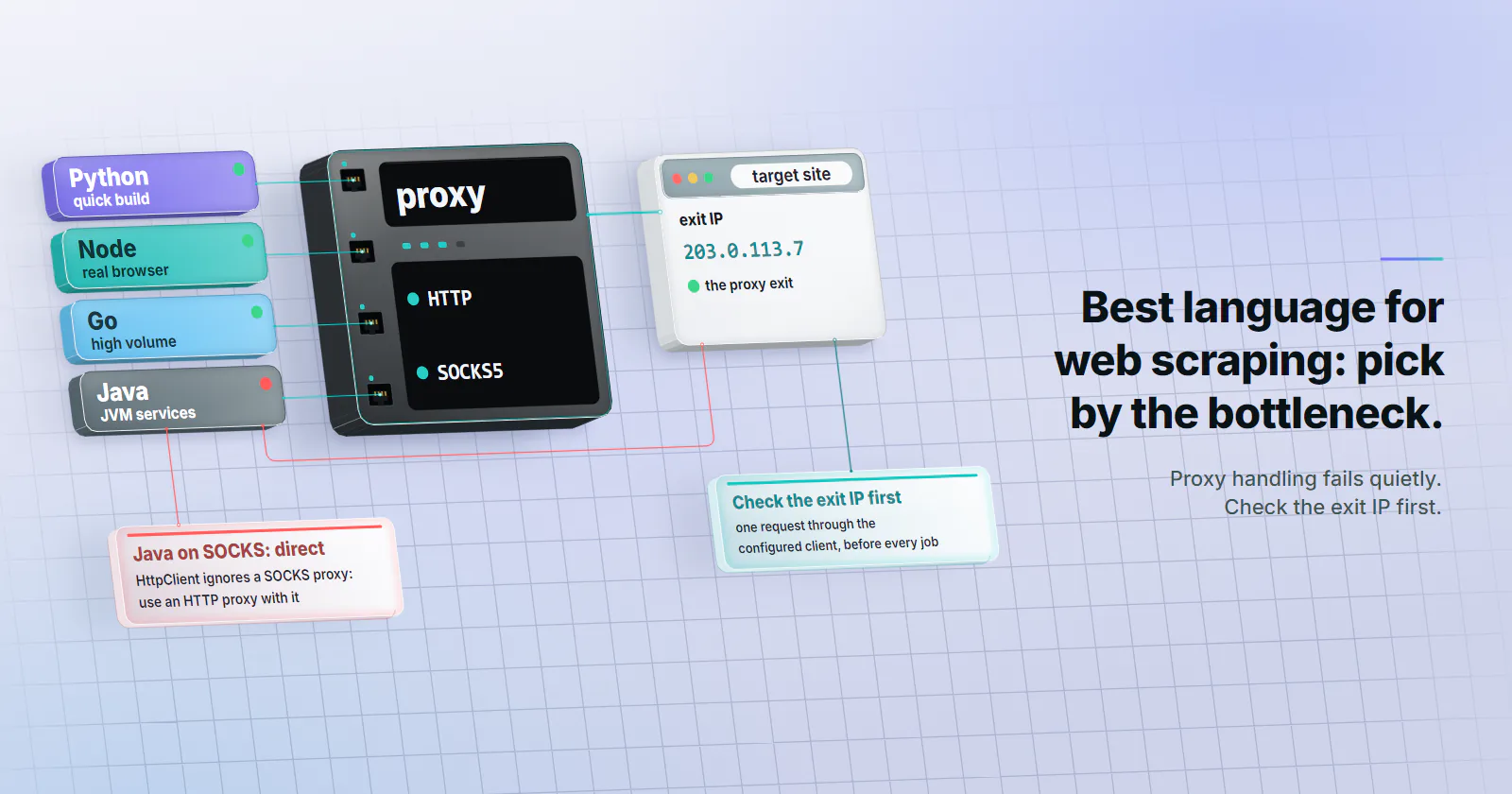
- Pick the language by the bottleneck. Parsing tools, concurrency model, headless browser support and proxy handling decide more than raw speed on I/O-bound scraping.
- Python has the widest scraping libraries. requests, httpx, aiohttp, BeautifulSoup, lxml, Scrapy and an official Playwright API make it the fastest route to a first working scraper.
- Node is the browser-native choice. Playwright and Puppeteer run natively, and undici's ProxyAgent handles HTTP proxies, with SOCKS5 support still marked experimental.
- Go has the cleanest proxy support. The standard library takes http, https, socks5 and socks5h proxy URLs and resolves hostnames at the proxy for SOCKS5.
- Java's built-in HttpClient has two proxy traps. Basic proxy authentication is disabled for HTTPS tunnels by default, and a SOCKS proxy is ignored so requests leave from the machine's own address.
Python is the best language for web scraping for most jobs: it has the widest set of scraping libraries and the shortest path to a working scraper. Node fits targets that need a real browser, Go fits jobs limited by requests per second per machine, and Java fits teams already on the JVM. The right pick is the language whose weak spot misses the job’s bottleneck.
The scraper worked on a laptop and fell over in production. Or it ran fine through an HTTP proxy, then the team switched to SOCKS5 and the Java client quietly started connecting from the server’s own address. Language comparisons rarely catch either problem, because they rank syntax and popularity.
Best language for web scraping at a glance
Each row names what the language is best at, where it hurts, and where most scrapers in it start.
How to choose a scraping language
Most scraping jobs are I/O-bound. The process spends its time waiting on the network, not computing. So raw language speed matters less than it looks, and five other questions decide more. One comes before all of them: if the site offers an official API or a data export, the job needs a good HTTP client and a JSON parser, which every language here has.
Team skills. The language the team already ships and debugs in production beats a faster one nobody on call can read. A scraper is maintenance work: selectors break, targets change, proxies need rotating.
Parsing and extraction. How much ready-made tooling exists for messy HTML, CSS selectors, XPath and pagination. This decides how fast the first version ships.
Concurrency model. How cheaply the language keeps hundreds of requests in flight. This decides throughput per machine, and with it the number of proxy connections the job holds open.
Headless browsers. Whether a JavaScript-heavy target can be driven from the same codebase with a first-party browser library. Playwright’s language list (checked September 2026) names JavaScript and TypeScript, Python, Java and .NET, all on the same underlying implementation, so one Playwright proxy setup carries across them.
Proxy support. Whether the default HTTP client takes an authenticated HTTP proxy and a SOCKS5 proxy without extra packages, and where it resolves DNS. This is where the languages differ most.
Python: the widest scraping libraries
Python has the deepest set of scraping libraries: requests and httpx for HTTP, aiohttp for asyncio, BeautifulSoup, lxml and parsel for parsing, and Scrapy as a full crawling framework. Playwright ships an official Python API. For a team starting from zero, Python gives the shortest time to a working scraper. It is also the usual pick as the best language for web scraping for beginners, because the tutorials and answered questions outnumber every other language’s.
Proxy support is good, though each client takes it a little differently.
requests. Pass a proxies dictionary per request. The requests advanced guide (checked September 2026) warns that values set on session.proxies can be overwritten by environment proxies, and recommends passing proxies on each call. SOCKS needs pip install "requests[socks]", and the scheme decides DNS: socks5 resolves on the client, socks5h on the proxy, a split covered in SOCKS5 vs HTTP proxy. The difference shows up at the target. On proxymint’s per-GB gateway, measured in September 2026, socks5h and HTTP CONNECT lookups resolved on the proxy side (our US test exits used US public resolvers), while plain socks5 used the client’s own resolver, so a scraper in another country looked up every hostname from there.
import requests
from urllib.parse import quote

user, password = quote("USERNAME", safe=""), quote("PASSWORD", safe="")
proxy = f"http://{user}:{password}@HOST:PORT"
proxies = {"http": proxy, "https": proxy}

with requests.Session() as s:
    r = s.get("https://example.com/", proxies=proxies, timeout=(5, 30))
    print(r.status_code)
httpx. Takes a single proxy argument. The httpx changelog records that proxy arrived in 0.26.0 (December 2023) and the old proxies argument was removed in 0.28.0 (November 2024), so older snippets break on current versions. SOCKS needs pip install "httpx[socks]".
import httpx
from urllib.parse import quote

proxy = f"http://{quote('USERNAME', safe='')}:{quote('PASSWORD', safe='')}@HOST:PORT"
with httpx.Client(proxy=proxy, timeout=30) as client:
    r = client.get("https://example.com/")
    print(r.status_code)
aiohttp. Takes proxy= per request or per session and supports HTTP proxies with CONNECT for HTTPS targets. It has no SOCKS support in the core library; the third-party aiohttp-socks package adds a connector for it.
The weak spot is CPU. Parsing large pages in pure Python on one core becomes the bottleneck at high volume, and the usual fix is more processes, not more threads. That may change slowly: PEP 779 (accepted June 2025) made the free-threaded build, which runs without the global interpreter lock, officially supported from Python 3.14, but still optional and not the default. Check that every parsing library supports it before relying on it.
Node: the browser-native option
Node’s strength is the browser. When most targets render their data with JavaScript, Node is the strongest candidate. Playwright started as a Node library and Puppeteer is Node-only, so a JavaScript-heavy target is driven from the same runtime that does the HTTP work. For static pages, cheerio gives jQuery-style selectors. The event loop keeps hundreds of requests in flight on one thread without extra setup.
Node’s own fetch reads HTTP_PROXY and HTTPS_PROXY when started with NODE_USE_ENV_PROXY=1, per the Node.js enterprise network guide (checked September 2026), from v22.21.0 and v24.0.0. For per-request control, undici’s ProxyAgent is the direct route. Its documentation (undici 8.x, checked September 2026) covers http://, https:// and socks5:// proxy URLs, with SOCKS5 handed to a Socks5ProxyAgent that is still marked experimental and sends hostnames to the proxy for resolution.
import { fetch, ProxyAgent } from 'undici';

const user = encodeURIComponent('USERNAME');
const pass = encodeURIComponent('PASSWORD');
const dispatcher = new ProxyAgent(`http://${user}:${pass}@HOST:PORT`);
const res = await fetch('https://example.com/', { dispatcher });
console.log(res.status);
axios has a proxy option for HTTP proxies. For SOCKS5 it needs an agent package such as socks-proxy-agent. The weak spot is the same as Python’s: CPU-heavy parsing blocks the event loop, so large extraction jobs move to worker threads.
Go: cheapest concurrency per request
Go is the pick when the bottleneck is throughput per machine. Goroutines make one-request-per-goroutine the normal style, and the standard library’s HTTP client is production-grade without add-ons. Colly and goquery cover crawling and CSS-selector parsing. The library set is thinner than Python’s, and browser automation relies on community libraries such as chromedp rather than a first-party Playwright.
Proxy support is the cleanest of the four. The Proxy field on http.Transport accepts http, https, socks5 and socks5h URLs, per the net/http source documentation (checked September 2026). The same comment notes that socks5 is treated the same as socks5h, so hostnames go to the proxy either way. Credentials in the URL become a Proxy-Authorization header.
package main

import (
	"fmt"
	"net/http"
	"net/url"
	"time"
)

func main() {
	proxyURL := &url.URL{
		Scheme: "http",
		User:   url.UserPassword("USERNAME", "PASSWORD"), // escaped when the URL is built
		Host:   "HOST:PORT",
	}
	client := &http.Client{
		Transport: &http.Transport{Proxy: http.ProxyURL(proxyURL)},
		Timeout:   30 * time.Second,
	}
	resp, err := client.Get("https://example.com/")
	if err != nil {
		panic(err)
	}
	defer resp.Body.Close()
	fmt.Println(resp.StatusCode)
}
Set Scheme to "socks5" and the same code runs over SOCKS5, no extra package.
Java: strong threads, proxy traps
Java suits teams that already run JVM services. jsoup handles HTML parsing, Playwright has an official Java API, and JEP 444 (delivered in JDK 21, September 2023) added virtual threads, which bring back thread-per-request code at high concurrency without an async rewrite.
The built-in java.net.http.HttpClient is where the traps are.
Basic proxy auth on HTTPS is off by default. The JDK’s net.properties file (checked September 2026) ships with jdk.http.auth.tunneling.disabledSchemes=Basic, and the HttpClient only implements Basic authentication. So an HTTPS request through a username-and-password proxy gets a 407 Proxy Authentication Required until that property is cleared when the JVM starts.
SOCKS is not supported. JDK-8214516, open since November 2018, records that the HttpClient ignores a SOCKS proxy returned by a ProxySelector. The request falls back to a direct connection from the machine’s own address.
// Run with: java -Djdk.http.auth.tunneling.disabledSchemes= ProxyFetch.java
import java.net.Authenticator;
import java.net.InetSocketAddress;
import java.net.PasswordAuthentication;
import java.net.ProxySelector;
import java.net.URI;
import java.net.http.HttpClient;
import java.net.http.HttpRequest;
import java.net.http.HttpResponse;
import java.time.Duration;

public class ProxyFetch {
    public static void main(String[] args) throws Exception {
        HttpClient client = HttpClient.newBuilder()
            .proxy(ProxySelector.of(new InetSocketAddress("HOST", PORT)))
            .authenticator(new Authenticator() {
                @Override
                protected PasswordAuthentication getPasswordAuthentication() {
                    if (getRequestorType() == RequestorType.PROXY) {
                        return new PasswordAuthentication("USERNAME", "PASSWORD".toCharArray());
                    }
                    return null;
                }
            })
            .connectTimeout(Duration.ofSeconds(10))
            .build();

        HttpRequest request = HttpRequest.newBuilder(URI.create("https://example.com/"))
            .timeout(Duration.ofSeconds(30))
            .build();
        HttpResponse<String> response = client.send(request, HttpResponse.BodyHandlers.ofString());
        System.out.println(response.statusCode());
    }
}
The -D flag on the first line fixes the 407. Set it in the service’s start script too, or the job works locally and fails in production.
Other languages: C#, Ruby, PHP, Rust
Each of these four is a sound pick when the team already runs it, and each has one proxy detail to get right.
C# and .NET. A solid pick for Microsoft shops. AngleSharp and HtmlAgilityPack parse HTML, and Playwright has an official .NET API. The built-in HttpClient takes a WebProxy, and the .NET 6 networking post (December 2021) records that SocketsHttpHandler accepts SOCKS4, SOCKS4a and SOCKS5 proxies from .NET 6 on, set with a socks5:// URL. That makes it friendlier to SOCKS than Java’s built-in client.
Rust. Fast, with low memory per open connection, which helps long-running crawlers. It is slower to write and has fewer scraping-specific libraries: reqwest for HTTP and the scraper crate for CSS selectors. The reqwest Proxy docs (0.13.5, September 2026) cover HTTP and HTTPS proxies, with SOCKS5 only after enabling the socks cargo feature.
Ruby. Nokogiri is a mature parser, and Faraday or HTTParty handle requests. Ruby fits a scraper that lives inside an existing Rails app as a background job. For a standalone crawler, Python has more tooling for the same effort.
PHP. Guzzle has a proxy request option and Symfony’s DomCrawler parses HTML. It fits scheduled jobs inside an existing PHP site, rarely a standalone crawler.
Speed, performance and blocking
The fastest language for web scraping on paper is a compiled one. Go and Rust usually complete the most requests per CPU core and hold the least memory per open connection. But on most jobs that is not the limit. The process waits on the network, the target’s response time and its rate limits cap throughput long before the language does.
Speed multipliers quoted without a method are guesses. Measure the actual job instead:
- Pick one static page and one fixed concurrency, for example 50 requests in flight.
- Run it against a server the team controls, without a proxy, so the network path is identical and nothing on the far side rate-limits the test.
- Record completed responses per minute, errors and peak memory for 10 minutes per language.
- Test the proxy separately. One static IP handles about 10 to 20 requests a second, so a benchmark through a single port measures the port, not the language.
- Repeat with a headless browser. Page rendering then dominates CPU and memory, and the language driving the browser barely moves the result.
Blocking changes the picture more than speed. A faster scraper reaches a target’s limits sooner. An HTTP 429 means too many requests, and RFC 6585 (April 2012) lets the server say how long to wait in a Retry-After header. Honour it, collect only public data, and read the site’s terms and robots.txt before the first run. A block or a challenge page is a signal to slow down or stop; switching language does not change what the target sees.
Proxy support by language
The table below covers the failure that costs the most and shows up in no benchmark: a client that ignores the proxy and sends traffic from the server’s own address.
Whatever the language, verify the exit before the job runs: request an IP-echo endpoint through the configured client and compare the answer with the proxy’s expected address. It takes one line and catches the silent-bypass cases above.
The proxy tier is a separate decision from the language. High-volume jobs against lenient targets fit datacenter proxies: dedicated IPv4 ports with no bandwidth cap, so a Go or Node scraper with high concurrency does not pay per GB. One static IP carries about 10 to 20 requests a second, so size ports for the concurrency the job runs, with the target’s own rate limits as the ceiling. Targets that score hosting ranges fit rotating residential proxies, billed per GB, where page weight matters more than the language. A job fetching 10,000 pages of about 2 MB each moves roughly 20 GB, which fits a 25 GB package. The tier tradeoffs are laid out on the proxy types overview and in datacenter vs residential proxies.
Which language fits the bottleneck
Pick the best language for web scraping by the constraint that will hurt first:
- If the team needs a working scraper this week, or the job is parsing-heavy, use Python. It has the widest scraping libraries, and requests or httpx take a proxy in one argument.
- If most targets need a real browser, use Node. Playwright and Puppeteer are native there, and one runtime covers both HTTP and browser work.
- If the bottleneck is requests per second per machine, use Go. Goroutines are cheap, and HTTP and SOCKS5 proxies work from the standard library.
- If the scraper lives inside existing JVM services, use Java with virtual threads, keep the built-in HttpClient on an HTTP proxy, and clear the tunneling property in the start script.
- If the team runs .NET, Ruby or PHP already, stay there for small and medium jobs. Move only when the tooling slows the team down.
Switching languages does not fix a blocked scraper either; a block is the target’s answer, and slowing down or stopping is the response.
Frequently asked questions
For most jobs it is Python, because it has the widest parsing and crawling libraries and the shortest path to a working scraper. Node fits browser-heavy targets because Playwright and Puppeteer run natively, Go fits high-throughput jobs with its cheap goroutines and standard-library proxy support, and Java fits teams already on the JVM.
Python is usually better for parsing-heavy jobs and quick builds, with requests, httpx, BeautifulSoup, lxml and Scrapy. JavaScript on Node is usually better when most targets need a headless browser, since Playwright and Puppeteer are native there. Both keep many requests in flight well, and both slow down when heavy parsing blocks a single core.
Compiled languages such as Go and Rust usually complete the most requests per CPU core and hold the least memory per open connection. On most scraping jobs that difference is small, because the process spends its time waiting on the network and the target's rate limits cap throughput first. Measuring the actual job at a fixed concurrency is the only reliable comparison.
Python. requests and BeautifulSoup fetch and parse a static page in a few lines, the documentation and tutorials are the most plentiful, and Scrapy and Playwright are there when the job grows. A beginner who already writes JavaScript for the web can start with Node and cheerio instead.
Yes, for throughput-bound jobs. Goroutines make one request per goroutine a normal pattern, and the standard HTTP client supports http, https, socks5 and socks5h proxies without extra packages. The parsing library set is smaller than Python's, with Colly and goquery as the main libraries, and browser automation relies on community libraries.
They add one more test: does the language's HTTP client take an authenticated HTTP proxy and a SOCKS5 proxy, and does it fail loudly when it cannot. Python, Node and Go handle both with at most one extra package. Java's built-in HttpClient needs a JVM property for HTTPS through an authenticated proxy and ignores SOCKS proxies, so it connects from the machine's own address.
No. The built-in java.net.http.HttpClient supports HTTP proxies only, and OpenJDK issue JDK-8214516 records that a SOCKS proxy returned by a ProxySelector is ignored, so the request connects directly. Use an HTTP proxy with it, or a different client library that supports SOCKS.
Researched and drafted with AI tools, then checked against our publishing rules before it went live: 13 outside links, 7 links to other proxymint pages, no prices and a fact-check pass against our product records. How we write.