Best proxies for web scraping: match the proxy to the job
The best proxies for web scraping depend on the target. Datacenter, residential, ISP and mobile compared by job, with billing models and a test to run first.
Quick summary · TL;DR
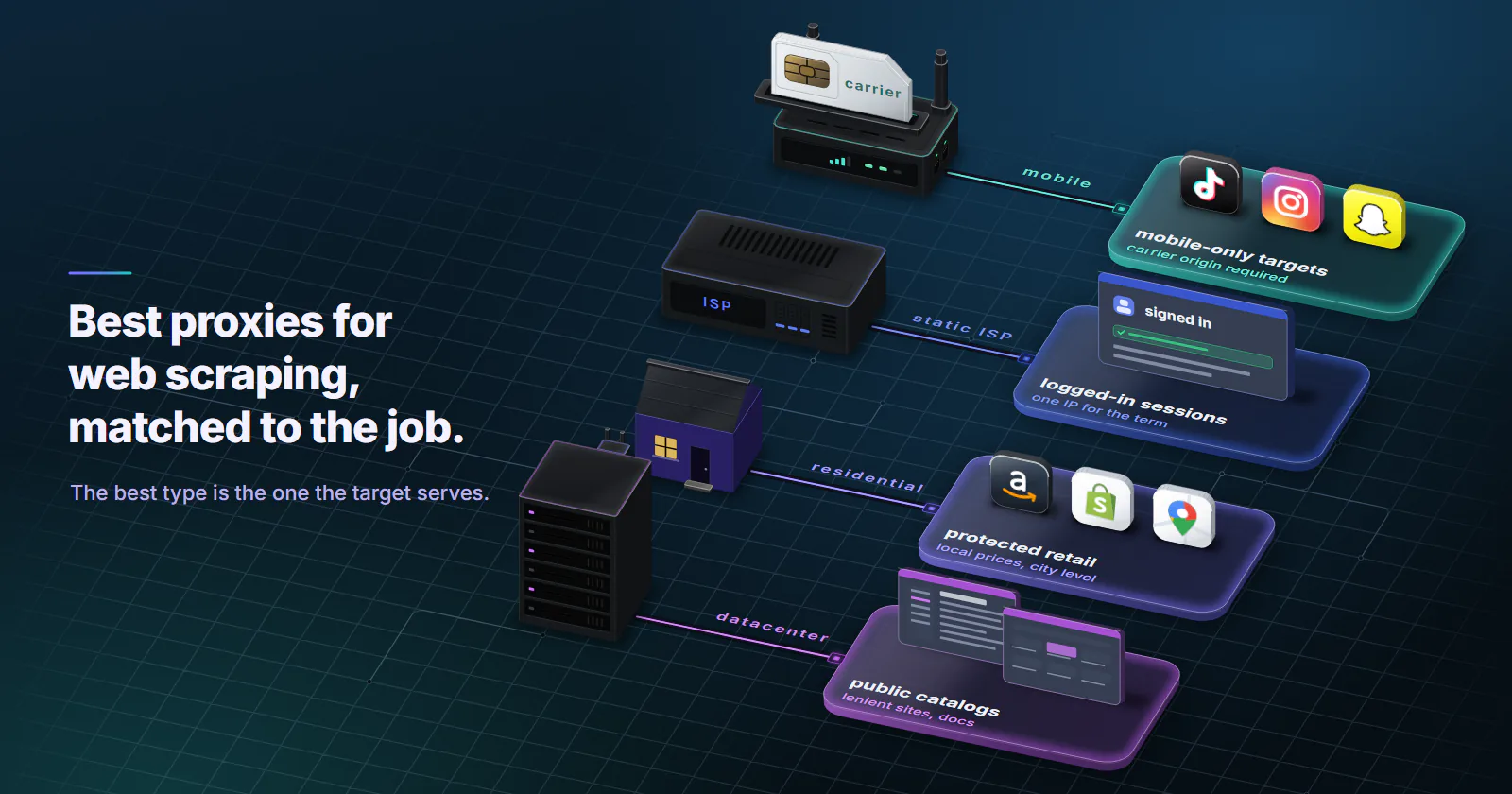
- The best proxy is the type the target serves correctly. Datacenter for lenient sites and public catalogs, rotating residential for targets that filter hosting ranges, static ISP for long logged-in sessions, mobile only where a carrier origin is required.
- A proxy changes only the address. It sets the exit IP, its network owner and its location. Headers, the TLS handshake and the request rate still come from the client, and so do DNS lookups unless the proxy URL says otherwise.
- Measure cost per valid record. Per-port datacenter bills addresses and per-GB residential bills traffic, so page weight and the target's filtering decide which fits a job.
- Pilot before scaling. 200-500 real URLs on the tier the job calls for, with a home-connection control, show whether the data matches what a visitor sees.
- A block means stop. Official API first, robots.txt and 429 respected, public data only.
The best proxies for web scraping are the type the target accepts. For lenient sites and public catalogs, that is datacenter. For targets that filter hosting ranges, it is rotating residential. Static ISP fits logged-in or session-bound flows, and mobile only fits targets that insist on a carrier origin. Pick by the job, then test a sample before scaling.
Most “best proxy” pages are vendor rankings. The scores come from the author’s own tests or from success rates the vendors publish about themselves. A buyer ends up choosing a brand before knowing which type of address the job needs.
This guide skips the ranking. It matches each proxy type to a scraping job, shows how to size a job, and gives a pilot test that settles the choice on the real target.
Best proxies for web scraping, by job
The target decides. A public product catalog with no bot scoring serves a datacenter request the same way it serves a browser. A strict retail site running an anti-bot vendor may challenge every hosting address on sight. The first target does not need residential trust; sending datacenter traffic to the second wastes the run.
| Job | Start with | Why | Wrong choice |
|---|---|---|---|
| Public catalogs, docs, lenient sites | Datacenter | Fastest, built for volume, flat monthly billing | Mobile: carrier trust the target does not check |
| Price and stock monitoring on protected retail | Rotating residential | Consumer ISP addresses clear filters that block hosting ranges | Static ISP: a fixed set of IPs burns out |
| Location-specific data (regional prices, local listings) | Rotating residential, city set on the order | Country, region and city targeting from live supply, one location per package | Datacenter, when the target filters hosting ranges |
| Logged-in dashboards, multi-step session flows | Static ISP | One address held for the whole term, so cookies survive | Per-request rotation: breaks the session |
| Targets that accept only a mobile origin | Mobile | Mobile carrier networks, often behind CGNAT | Mobile where no carrier origin is required |
A proxy type sets a floor. The request rate, headers and client still decide whether a page is served. Most jobs also mix tiers, so route per target rather than per company.
Why scrapers need proxies at all
A proxy changes three things the target can see: the exit IP, the network that announced it (the ASN, which tells a hosting company from a home ISP), and the location attached to it. It changes nothing else. The User-Agent, the TLS handshake, cookies and the request rate all come from the scraper’s own client.
Spread. A crawl of many pages can leave from many addresses instead of one server. The pace still has to be one the target allows; volume past that belongs on its API or data feed, not on more exits.
Location. Prices, stock and search results change by country and city. A scraper in Frankfurt sees German prices unless it exits somewhere else.
Network type. Some targets filter by who owns the address. A datacenter range gets a challenge page; a home ISP address gets the product page.
When no proxy is needed. A job of a few hundred pages a day from one public site, at a polite pace, often runs fine from the scraper’s own server. Try that first. If the target offers an official API or a data export, that route beats any proxy.
Why a VPN is the wrong tool. A consumer VPN gives one shared exit per connection, typically on a hosting range, with no per-request control, and many VPN terms forbid automated traffic. It suits a person browsing, where a scraper needs to spread load.
Where DNS and headers come from
Two leaks undo a good exit, and neither shows up in a status code. The first is DNS. With a plain socks5:// URL the scraper resolves the target hostname itself, so a CDN that routes by resolver location can hand it the edge nearest the scraper’s server instead of the one nearest the exit. On proxymint’s residential and mobile per-GB tiers, HTTP CONNECT and socks5h:// resolve names on the proxy side; plain socks5:// leaves the lookup to the scraper’s machine.
The second is headers. Our gateway measured no Via and no Forwarded header at the target, and over CONNECT it only relays encrypted bytes, so it has no way to add X-Forwarded-For either. Whatever the scraper’s client sends goes through as sent. A client that sets its own X-Forwarded-For hands the target its real address.
In Python with requests (install requests[socks] for SOCKS support), the whole setup is one URL:
import requests
from urllib.parse import quote

# Percent-encode the login so @, : or / in a password cannot break the URL
user = quote("USERNAME", safe="")
password = quote("PASSWORD", safe="")
proxy = f"socks5h://{user}:{password}@gw.proxymint.com:PORT"
r = requests.get(
    "https://example.com/",
    proxies={"http": proxy, "https": proxy},
    timeout=30,
)
print(r.status_code)
Every proxymint tier authenticates with a username and password, and both HTTP and SOCKS5 are included. Write the proxy URL with http://, or socks5h:// on the per-GB tiers; the connection to the target stays HTTPS inside the tunnel. Request https:// URLs: the per-GB gateway answers a plain http:// target with a 301 to its HTTPS address.
Proxy types for web scraping
Four sources of addresses matter, and each has a job it is best at and one it is wrong for. Rotation and protocol are separate choices on top. Types of proxies covers the wider taxonomy, including protocol and anonymity levels.
Datacenter proxies
Datacenter exits sit on server uplinks, so they are fast, and a port bills the same whether it moves 1 GB or 50. The catch is the ASN: a target can see a hosting company announced the address before reading a single header. On lenient targets that does not matter. Datacenter proxies at proxymint are dedicated IPv4 ports, each with its own username and password and an HTTP and a SOCKS5 port, chosen by country. The checkout listed 37 countries on 2026-09-27. What are datacenter proxies shows how to test whether a target filters them.
Residential proxies
Residential exits run through real home connections, so the address belongs to a consumer ISP. That is what clears targets that filter hosting ranges, and it is why residential is sold per GB: every byte crosses someone’s home line. What is a residential proxy covers the mechanics. On proxymint’s rotating residential proxies, rotation is set on the order (a new IP on every request, a timer from 5 to 60 minutes, or sticky while the device stays online) and can be changed after purchase. Location is country, region and city from live supply; the checkout listed 227 countries on 2026-09-27. Location belongs to the package, not the request, so scraping regional prices in five cities takes five packages. Residential is overkill for lenient targets, and home devices go offline, so it will not hold one identity for days.
ISP proxies
ISP proxies are addresses registered to ISPs but hosted on datacenter servers, held for the whole billing term. They keep a login alive across a week of runs, which rotating residential cannot. They are the wrong tool for broad scraping: a fixed set of addresses doing thousands of requests gets rate limited, and a new set costs another month. Static ISP proxies at proxymint come with a username, password, HTTP and SOCKS5 port per IP. What are ISP proxies explains the address type, and ISP proxies vs rotating residential covers the split in depth.
Mobile proxies
Mobile exits use mobile carrier networks, often behind CGNAT, where many subscribers share one public IP. That is premium infrastructure to run, built for targets that check for a carrier origin. CGNAT proxies explained covers why. Catalog scraping and price monitoring rarely check for a carrier origin, so residential or datacenter serve them. Use mobile proxies only when a target serves mobile origins and nothing else; what are mobile proxies lists the cases.
Rotation and pool sizing
Rotation sets how long one address carries the scraper’s traffic, and it is chosen separately from the proxy type.
Rotate on every request for stateless page fetches: product pages, search results, listings. Each request leaves from a new exit, at the pace the target allows.
Rotate on a timer when a short flow spans several requests, such as a paginated category that sets a cookie on page one. A 10 or 15 minute timer keeps the flow on one address, then moves on.
Stay sticky or static for logged-in work. A login that jumps between cities every request is the fastest way to trigger a security check on an account the reader owns.
How many proxies a job needs
On per-GB residential, the count of IPs is not the bill; the gigabytes are. On per-port datacenter and ISP, the count is the bill, so size it from what the job holds at once:
ports needed = logins, sessions or locations that run at the same time
The target sets the pace for the whole job, not per address. Read its published limits and any Retry-After header, and keep the total under them. More addresses do not raise what a site allows; volume past that belongs on the site’s API or data feed.
Cost per valid record
A proxy that returns challenge pages costs more than its rate suggests. The number to compare is cost per record that matches what a real visitor sees:
cost per valid record = job cost / requests whose content matches a home-connection control
Page weight moves the answer more than the rate card. The HTTP Archive’s 2024 Web Almanac put the median HTML document at 18 KB and the median full mobile page at 2,311 KB in its October 2024 crawl. Product pages with embedded data, redirects and headers run heavier than a median homepage, so a scraper that fetches HTML only can budget about 100 KB per page, and one that renders every asset should budget about 2 MB.
Light HTML pages. At about 100 KB a page, a 100,000-page job moves about 10 GB. Per-GB residential bills those gigabytes; a per-port datacenter plan bills the addresses, whatever they move, so a heavy job on a lenient target suits ports and a light job on a filtered target suits residential.
Full browser renders. At about 2 MB a page, the same 100,000 pages move about 200 GB, twenty times the traffic of the HTML-only run. Blocking images, fonts and media in the headless browser cuts that sharply and costs nothing; the usage counter shows by how much.
Mobile. Carrier bandwidth is premium infrastructure, built for targets that require a mobile origin. A target that already serves residential does not need it.
When a scraping API costs less
A scraping API bills per successful request and handles retries, rendering and rotation itself. It wins when the team is small, the targets are hard and nobody wants to run headless browsers. A proxy network wins on volume, on control over pace and location, and when the scraper already exists.
Test proxies before committing
A one-day pilot settles the best proxies for web scraping on a given target better than any ranking, including this one.
- Build a sample. 200-500 real URLs from the target, mixed across page types.
- Keep everything fixed. Same client, headers and pace as the production job, on the tier the job calls for.
- Add a control. Fetch a slice of the same URLs from a home connection with no proxy.
- Sort every response into served normally, blocked (403, 429), challenged, or served different content.
- Compare content, not status codes. A 200 with different prices or an empty result list is silent bad data.
- Read metered bytes from the usage counter instead of guessing page weight, then work out cost per valid record.
If responses come back blocked or challenged, the site is saying no: slow down, check its terms or use its official route. If the home control is challenged too, the client or the pace is the problem, and a better address will not fix it.
Vetting a proxy provider
For residential and mobile, where the addresses come from matters as much as the price. In May 2024 the US Department of Justice dismantled the 911 S5 residential proxy botnet (justice.gov, 2024-05-29), whose infected devices were associated with more than 19 million unique IP addresses. On 2026-01-28 Google’s Threat Intelligence Group described disrupting the IPIDEA residential proxy network, whose SDKs enrolled devices through apps, including free VPNs, without clear disclosure to the user.
Ask any provider how devices joined the pool and whether owners can opt out. proxymint’s residential exits come from device owners who opted in and can opt out at any time.
Free proxies and public proxy lists. They fail on every axis a scraper cares about. The addresses are shared with everyone who found the list, many are already blocked on popular targets, uptime is unpredictable, and the operator can read or alter unencrypted traffic. A list also shifts the rotation work onto the scraper. A per-GB gateway or a set of dedicated ports removes the list entirely.
Rules, blocks and legal limits
The best proxies for web scraping do not change what a site allows. Start with the official route: many targets publish an API, a data feed or an export that is faster and steadier than any scraper.
Read robots.txt. The Robots Exclusion Protocol is RFC 9309 (IETF Proposed Standard, September 2022). The RFC says its rules are not a form of access authorization; honoring them is still the baseline for a scraper that means to keep running.
Treat 429 as an instruction. RFC 6585 (IETF, April 2012) defines 429 Too Many Requests and lets the server say how long to wait in a Retry-After header. Slow down to that pace; do not rotate around it.
Collect public data only. No logins that are not the reader’s own, no personal data without a lawful basis, and no paywalled content.
Whether a given job is legal depends on the jurisdiction, the site’s terms and the data involved. This is not legal advice; for anything beyond public, non-personal data, ask a lawyer before the first run.
Choosing the best proxies for web scraping
Pick the tier by the job, then run the pilot on it:
- Public data on a lenient site: datacenter ports. They are built for that workload.
- A target that filters hosting ranges by policy: rotating residential, per request for page fetches, on a timer for short flows.
- The job needs one address for days, such as a logged-in dashboard the reader owns: use static ISP.
- The target serves only mobile origins: use mobile, and only for that target.
- The pilot comes back blocked or challenged: slow down, fix the client, or use the site’s official route. A different proxy will not help.
Frequently asked questions
The type the target serves correctly. Datacenter proxies suit lenient sites and public catalogs, rotating residential proxies suit targets that filter hosting ranges, static ISP proxies suit long logged-in sessions, and mobile proxies suit only targets that require a carrier origin. A short pilot on the real target settles it.
Only on targets that filter hosting ranges. There, residential addresses from consumer ISPs are served where datacenter addresses get challenged. On lenient targets datacenter is faster and built for volume. At proxymint datacenter is billed per port per month and residential per GB.
Start from what the job holds at once, not from a target's per-IP limit, because more addresses do not raise what a site allows. For per-port datacenter or ISP proxies, count the logins, sessions or locations that run at the same time. On per-GB rotating residential the IP count is not the bill; the traffic is.
Not for anything that has to work. Free proxies and public lists are shared with everyone who found them, many are already blocked on popular targets, uptime is unpredictable, and the operator can read unencrypted traffic. A small paid package costs less than the failed runs.
For stateless page fetches such as product pages and listings, yes: each request looks like a different visitor. For short multi-page flows, a 10 to 15 minute timer keeps the flow on one address. For logged-in work, use a sticky session or a static ISP address so the login does not jump between locations.
No. A proxy changes the address, but a captcha is the site asking whether a human is present, and it also reacts to request rate and client behaviour. The right response is to slow down, check the site's terms, or stop. Solving or bypassing captchas is evasion.
Using a proxy is legal in most jurisdictions. The legal risk sits in what the scraper collects and how: breaking a site's terms, collecting personal data without a lawful basis, or getting past access controls. Public, non-personal data collected at a polite pace is the safe baseline. This is not legal advice.
Researched and drafted with AI tools, then checked against our publishing rules before it went live: 5 outside links, 14 links to other proxymint pages, no prices and a fact-check pass against our product records. How we write.