IP reputation score: what it measures and how to read it
An IP reputation score rates how risky an address looks from blocklists, abuse reports and network type. How each scale works and how proxy IPs score.
Quick summary · TL;DR
- An IP reputation score is one vendor's risk rating for one address. It blends blocklist listings, abuse reports, the network type and past behaviour, and every vendor uses its own scale.
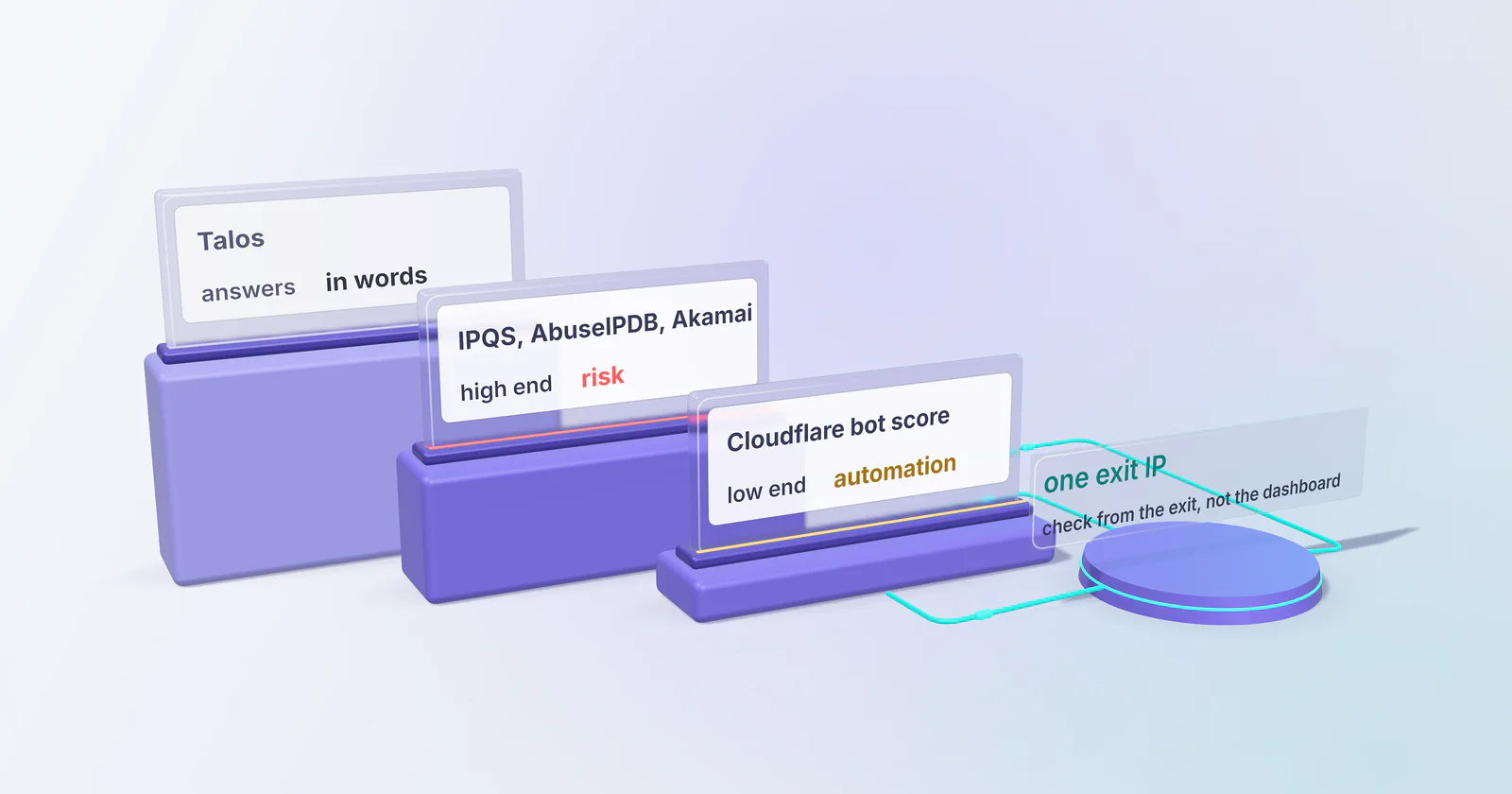
- The scales point in different directions. Cloudflare's bot score marks automation at the low end, while IPQS, AbuseIPDB and Akamai mark risk at the high end, and Talos answers in words.
- Proxy categories read differently. Datacenter exits carry a hosting label, static ISP addresses build their own history, rotating residential exits change too often for per-IP history to dominate, and mobile exits sit behind CGNAT.
- Check from the exit, not the dashboard. An IP lookup through the proxy, an ASN query and a DNSBL query from a resolver you control show what a target sees.
An IP reputation score is one vendor’s risk rating for one address, built from blocklist listings, abuse reports, the network the address belongs to and how traffic from it has behaved. Every vendor uses its own scale: some count up toward “risky”, some toward “human”, and email systems answer in words. A score only means something next to its scale.
The question usually arrives after something broke. A login asks for a second factor it never asked for before, a page returns a challenge instead of content, or a checker site paints an exit IP red. The reflex is to look up one number and trust it. That number is one vendor’s opinion, measured for one job, often email.
What an IP reputation score measures
Two layers, one number. Every IP reputation score blends what the network is with what the address has done. The network layer covers the autonomous system (ASN) that announces the range, the kind of connection behind it and whether the range belongs to a known VPN, proxy, Tor or hosting operator. The history layer covers spam traps hit, abuse reports filed and challenges failed by that exact address.
No universal score. Spamhaus, Cisco Talos, MaxMind, IPQS, AbuseIPDB and Cloudflare each keep their own data and their own scale. The same address can be “Neutral” for email at Talos, carry a fraud score in the 70s at one vendor and pass a bot check on a site behind Cloudflare, all on the same afternoon.
The site decides. The site receiving your request picks the vendor, the threshold and the action: allow, challenge, rate limit or block. Two sites using the same vendor can treat the same score differently.
Signals behind the score
Blocklists. DNS-based blocklists (DNSBLs) publish listed addresses as DNS records anyone can query. Spamhaus ZEN, for example, combines four lists in one zone: the SBL for spam sources and spam operations, the XBL for hosts infected with malware or exploited, the PBL for end-user ranges that should not send mail directly, and the CSS for low-reputation senders found automatically (Spamhaus ZEN, checked October 2026). A PBL entry is a policy statement about the range, not an accusation against the address.
Abuse reports. AbuseIPDB turns reports from its users into an “abuse confidence” from 0 to 100, weighted by how many distinct reporters filed and how recently, and describes the value as deliberately conservative (AbuseIPDB FAQ, checked October 2026). A handful of old reports from one reporter barely moves it.
Network type. IP intelligence databases label the network behind each range. MaxMind’s connection-type database (checked October 2026) returns Cable/DSL, Cellular, Corporate or Satellite. Hosting ranges carry their own flag. Many fraud and bot systems weight this label more than any single address’s history.
Anonymizer flags. MaxMind’s Anonymous IP database documentation (checked October 2026) lists six flags: is_anonymous, is_anonymous_vpn, is_hosting_provider, is_public_proxy, is_tor_exit_node and is_residential_proxy. The last one marks residential ISP addresses on a suspected anonymizing network.
Behaviour. Bot management products score the request as well as the address. Cloudflare’s bot score documentation (updated August 2026) names heuristics, machine learning and JavaScript detections among the engines behind its score. The IP is one input among several, and what the client does after connecting can outweigh it. Our guide to how websites detect proxies walks through each layer in order.
Neighbours. Reputation leaks across a range. A /24 full of listed addresses or an ASN known for abuse drags down a clean address inside it, which is why a fresh IP can start with a poor score.
Who scores IP reputation
Most confusion comes from comparing numbers built for different jobs. Email filters ask “will this sender spam my users”. Fraud scoring asks “is this checkout or signup risky”. Bot management asks “is a script making this request”. Each publishes a different scale.
| Scorer | Built for | Scale | Which end is bad |
|---|---|---|---|
| Cisco Talos | Email and web filtering | Good, Neutral, Poor | Poor |
| Microsoft SNDS | Mail into Outlook.com | Green, yellow, red | Red |
| Validity Sender Score | Email sending | 0-100 | Low (100 is best) |
| IPQS fraud score | Fraud and signups | 0-100 | High (75 suspicious, 90 high risk) |
| MaxMind minFraud IP risk | Fraud on transactions | 0.01-99, a percentage | High |
| AbuseIPDB | Abuse reports | 0-100 confidence | High |
| Cloudflare bot score | Bot management | 1-99 | Low (1 is automated) |
| Akamai bot score | Bot management | 0-100 | High (100 is a bot) |
Where each scale is defined, all checked October 2026:
- Talos sender reputation levels describe Neutral as within acceptable parameters.
- Sender Score rates sending IPs against each other on a rolling 30-day sample, so a high number is good there and bad at IPQS.
- The IPQS proxy detection API documentation calls 75 and above suspicious but not necessarily fraudulent, 90 and above high risk, and recommends flagging or blocking at 90 and above.
- MaxMind’s minFraud IP risk score is a percentage: 15.40 means a 15.4% chance of fraud from the IP alone.
- Akamai’s Bot Manager documentation puts humans at 0 and bots at 100.
Gmail no longer shows senders a number at all. Google retired the IP and domain reputation dashboards in Postmaster Tools on September 30, 2025, and the v2 interface reports spam rate and compliance instead (Postmastery, 2025).
Reading the scales
What a good score looks like
On a 0-100 risk scale such as IPQS or AbuseIPDB, lower is better, and the vendor’s own threshold is the line that counts: under 75 at IPQS is outside its “suspicious” band, and an AbuseIPDB confidence of 0 means no recent reports. MaxMind’s IP risk score is a percentage chance of fraud from the IP alone, so 0.5 means half a percent. On Cloudflare the logic flips: 30 to 99 reads as likely human and 1 to 29 as likely automated. For Talos, “Neutral” is a normal result: Talos describes it as within acceptable parameters, with mail that may still be filtered.
Why two checkers disagree
A checker site that shows a single red or green verdict is mixing these layers. One vendor flags the ASN, another has no reports, a third has seen the address on a residential proxy feed. The numbers disagree because they answer different questions with different data. Write down which vendor said what before acting on any of them.
Reputation by proxy type
A proxy exit carries both layers. Which layer dominates depends on the category, and so does the job it fits; the types of proxies overview compares the categories on everything else.
| Category | What the network layer says | How per-IP history behaves | Fits |
|---|---|---|---|
| Datacenter proxies | Hosting ASN, flagged as hosting on sight | Stable address, history accumulates | Targets that accept hosting networks, volume work |
| Static ISP proxies | ISP-registered range | One address for the term, its history is built by its traffic | Logins and sessions that need one consistent address |
| Rotating residential proxies | Home ISP network | Each request or session meets a different address | Broad consumer-origin coverage across many pages |
| Mobile proxies | Carrier network, cellular connection type | Shared by many subscribers behind CGNAT | Platforms and apps that expect a mobile origin |
Datacenter. The hosting label decides most outcomes here. A strict target reads the ASN and stops; a lenient one never looks past it. Per-address history matters on top of that, so a range with past abuse starts behind. On targets that accept hosting networks, a datacenter IP with a quiet history is a fast, predictable exit.
Static ISP. The address is registered to an ISP and stays assigned to the order for the whole term. That makes its reputation something you can measure on day one and watch afterwards, and the traffic you send through it shapes what it becomes. This is the category for ASN reputation plus a stable history, which is what account logins and long sessions reward.
Rotating residential. Per-IP history counts for less, because the address changes. IPinfo’s analysis of 170 million residential proxy IPs over 90 days (January 2026) found an average visibility of 4.56 days per address, which is why sites lean on the network type and on behaviour rather than an address’s long history. Our explainer on what a residential proxy is covers how the category works.
Mobile. Carriers place many subscribers behind one public IPv4 address with carrier-grade NAT. proxymint’s mobile exits run on carrier networks. Sites know a block on a carrier address hits real customers, so they tend to slow it down rather than ban it.
How to check an IP reputation score
Check the address the target sees, which is the exit, from the exit. Looking up the IP your provider dashboard prints is not the same thing when rotation is on. Replace USERNAME, PASSWORD, HOST and PORT with your own proxy details; 203.0.113.10 below is a documentation address from RFC 5737.
# 1. The exit IP and network the target sees
curl -s -x http://USERNAME:PASSWORD@HOST:PORT https://ipinfo.io/json

# 2. ASN, prefix and registry for that IP (Team Cymru)
whois -h whois.cymru.com " -v 203.0.113.10"

# 3. Spamhaus ZEN: reverse the octets and query the zone
dig +short 10.113.0.203.zen.spamhaus.org
The first call shows the exit and its network, the same way the proxymint Lab gateway test reads it. The second gives the ASN from Team Cymru’s IP to ASN mapping service (checked October 2026). An empty answer to the third means not listed. An answer of 127.255.255.254 is not a listing: Spamhaus returns that code when the query comes through a public or open resolver, and it carries no reputation data (Spamhaus, return codes, checked October 2026). Run it from a resolver you control or through Spamhaus’s free Data Query Service.
Then look the address up on AbuseIPDB and on one fraud vendor, and note the date next to each result. On a static address, repeat after a week of real traffic. On a rotating exit, sample 20 to 30 addresses and read the spread, because one address says almost nothing about the next one.
Why scores get it wrong
Shared addresses. Cloudflare’s CGNAT study (October 29, 2025) found CGNAT addresses were rate limited three times as often as other addresses, while the median bot rate behind them was nearly identical (4.8% against 4.7%). One subscriber’s behaviour lands on everyone sharing the address.
Churn. Residential addresses move between users faster than many lists refresh. A report filed against an address last month may describe someone else’s traffic.
Missing data. A Talos “Neutral” or an AbuseIPDB 0 can mean the address is new to that dataset, so an empty record proves less than a long clean one.
Range-level penalties. A listing for a whole range or a policy entry such as the PBL hits every address inside it, including ones that never sent anything.
How to improve a poor IP reputation score
On an address you control, fix the cause before asking anyone to delist it. Each blocklist publishes its own removal rule; some entries expire once the activity stops, and others stay until the operator files a request. Find which list or vendor flagged the address, read its reason, clean up the host or the traffic, then request removal where the list allows it. A mail server also needs SPF, DKIM and DMARC in place, because mailbox providers check authentication alongside the address.
Through a proxy, the fix depends on the layer that caused the flag:
- History on one address. On a static ISP address, lower the request rate, keep sessions consistent and send only the traffic the target permits; the reputation follows the traffic.
- The network label. If a target rejects hosting ASNs, no amount of good behaviour on a datacenter IP changes the label. Match the category to the target instead.
- Behaviour on the target. A bot score falls when the client fails JavaScript checks or reuses a broken fingerprint. That lives in your client, and changing the IP does not fix it.
- A rotating exit with a poor reading. Read the spread across a sample before drawing a conclusion, and use sticky sessions where the target expects one visitor to stay on one address.
If the target shows a “proxy detected” message rather than a score, the proxy detected error guide triages it check by check. None of this overrides a target’s rules. A site that has blocked a job on purpose has answered the question, and a cleaner IP is not a reason to keep going.
Which score to watch for your job
If the job is sending mail, watch blocklists, Talos and SNDS, and ignore web fraud scores. If it is signing in to accounts you own, watch fraud scores and anonymizer flags on one stable address, which points to static ISP. If it is collecting public pages across many addresses, the per-IP number matters less than the network type and your client’s behaviour, which points to rotating residential, or to datacenter where the target accepts hosting networks. If the target is built for phones, the cellular label is the signal that counts, and mobile is the category that carries it.
Frequently asked questions
It depends on the scale. On 0-100 risk scales such as IPQS or AbuseIPDB lower is better, and IPQS treats 75 and above as suspicious and 90 and above as high risk, and recommends flagging or blocking at 90. On Cloudflare's 1-99 bot score, 30 and above reads as likely human. For Cisco Talos, Good and Neutral are both normal results.
Each vendor combines its own data: blocklist listings, abuse reports, the ASN and connection type of the range, anonymizer flags such as VPN, Tor, hosting or residential proxy, and how traffic from the address has behaved. The weighting is the vendor's own, which is why two checkers can disagree about the same IP.
Find the IP that targets see, then look it up in several places: an ASN lookup such as Team Cymru, a DNSBL such as Spamhaus ZEN queried from a resolver you control, AbuseIPDB for abuse reports, and one fraud-scoring vendor. Through a proxy, run the lookups from the exit, because the dashboard address can differ when rotation is on.
Find which list or vendor flagged the address and why, fix the cause, then follow that list's removal process. Through a proxy, lower the request rate on static addresses, match the proxy category to what the target accepts, and fix client behaviour that fails bot checks. A site that blocks a job on purpose has answered the question.
Common reasons are a blocklist entry, recent abuse reports, a hosting ASN, an anonymizer flag such as VPN or residential proxy, or a neighbouring range with a poor record. Shared addresses behind carrier-grade NAT can also inherit another subscriber's behaviour.
It depends on the list. Some blocklist entries expire on their own once the activity stops, while others stay until the operator requests removal. Fraud and bot scores refresh as new data arrives, so they recover only after the address has carried clean traffic for a while.
They can change how an address is labelled. IP intelligence databases flag VPN, hosting, public proxy, Tor and residential proxy addresses separately, and many fraud systems weight those flags. Whether a site acts on the flag is its own choice, and many score it together with behaviour rather than blocking outright.
Researched and drafted with AI tools, then checked against our publishing rules before it went live: 15 outside links, 11 links to other proxymint pages, no prices and a fact-check pass against our product records. How we write.