Proxies for market research: seeing each market as locals do
Which market research jobs need residential exits, where datacenter is enough, how to design a multi-market collection, and a sized 5-country weekly run.
Quick summary · TL;DR
- Market research needs the page a local customer gets. Prices, search results, ads and stock change by country, and many sites decide the version from the visitor's IP and Accept-Language header, not the URL.
- Check first whether the site keys on the URL or the IP. EU rules ban redirecting shoppers to a country version without consent, so many EU storefronts show a country's prices on its own URL from anywhere; the IP then changes only the extras.
- Split the job by target, not by market. Lenient storefronts run on flat-rate datacenter ports in each country; search results and pages built around a region or city go to residential per GB.
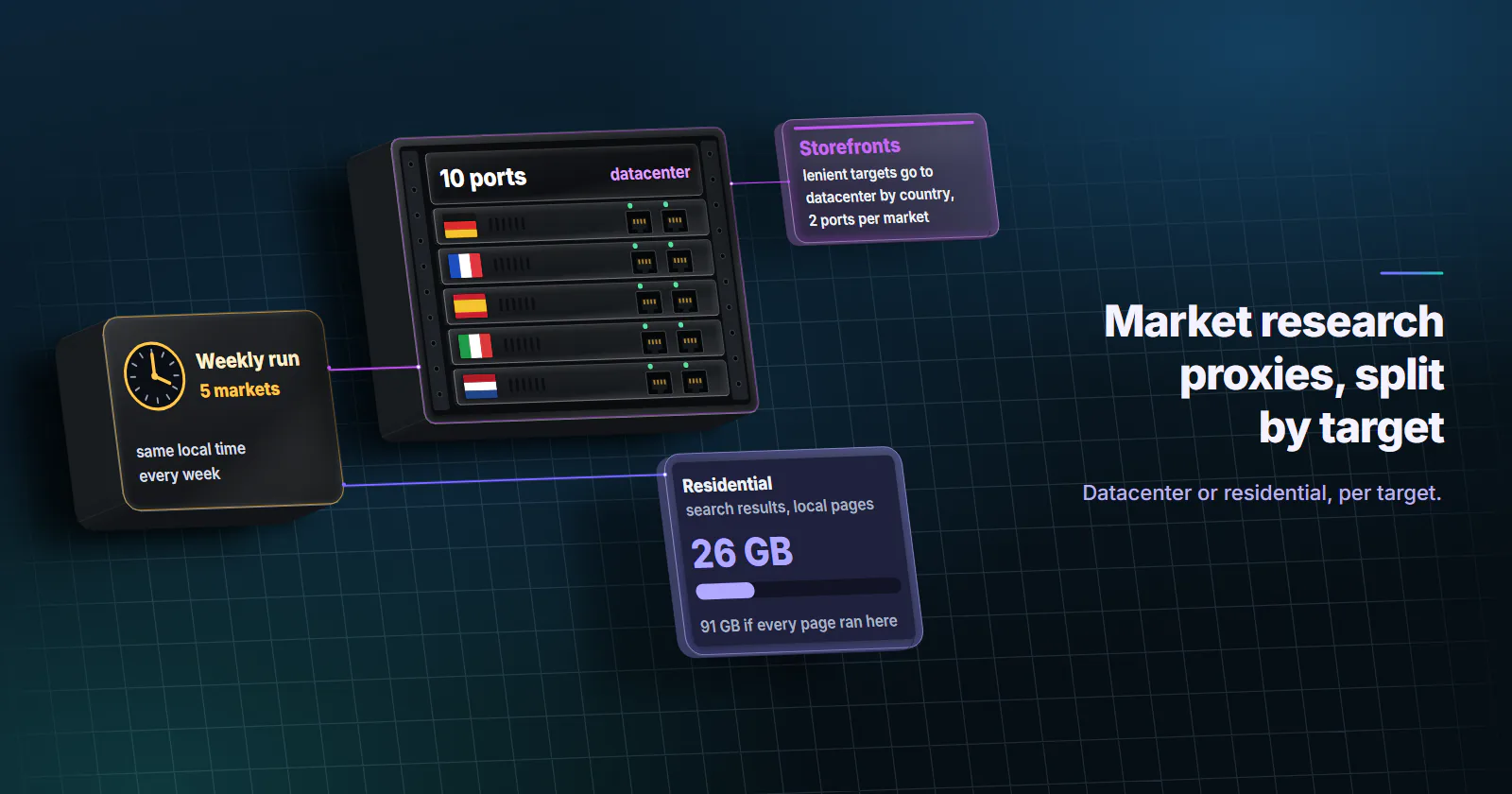
- Size a 5-country weekly run in bytes, not pages. The mixed design uses 10 datacenter ports plus a 26 GB residential package; rendering every page through residential would move 91 GB.
- Record what the site showed, not what was requested. Store the exit IP, the currency and country the page displayed, and the timestamp with every price.
Proxies for market research send each request through an exit in the market being studied, so prices, search results, ads and stock come back as a local customer sees them. Datacenter ports by country cover lenient storefronts at a flat monthly rate; residential exits cover pages built around a region or city, and search results, per GB. Check first whether a site picks the market from the URL or the IP.
A pricing analyst in Berlin opens a competitor’s French storefront and sees euro prices, a German delivery estimate and a banner for a promotion that only runs in Germany. The same page in Lyon shows a different promotion, a different delivery date and, sometimes, a different price. The analyst’s spreadsheet now holds a French price that no French customer ever saw.
That gap is the whole reason research teams route collection through other countries. The pages that matter to a market study, prices, search results, ads and stock, are built for the visitor’s location, and the location is read from the network. Vendor pages on the topic name providers. They rarely say which research jobs need a residential exit, which run fine on datacenter, or how to cover five markets without rendering every page through residential.
What proxies for market research fix
A site can decide which version of a page to serve from three inputs: the URL, the Accept-Language header, and the IP address. Google’s documentation on locale-adaptive pages (updated December 10, 2025) describes sites that return different content based on the perceived country or preferred language of the visitor, and notes that its own crawler mostly appears to be based in the USA and does not send Accept-Language. If Google’s crawler can miss the local version, so can a researcher’s laptop.
Market research proxies fix the IP input. They do not fix the other two. A request from a French exit with an English Accept-Language header and a US-sized viewport is a French IP pretending to be an English visitor, and some sites will serve it the English page. Every collection run has to set all three together: the exit country, a matching language header, and the storefront URL a local customer would use.
What changes by location. In most market studies the list is the same: displayed price and currency, tax display, local promotions, delivery options and dates, stock by store or region, sort order and search results, and the ads that run in that market.
URL-keyed or IP-keyed targets
Before buying anything, find out whether each target decides the market from the URL or from the IP. The answer can remove most of the proxied requests for that target.
In the EU, law pushes storefronts toward the URL. The European Commission’s summary of the Geo-blocking Regulation (published March 22, 2018) states that the regulation bans blocking access to websites and re-routing without the customer’s prior consent, so customers can reach each national website. A German visitor can usually open the French storefront by its URL, and the French prices are on it. For localized pricing research inside the EU, the country URL often carries the price, and the IP only changes the extras: delivery estimates, promotions and stock.
Outside the EU, no such rule applies. Many global retailers redirect on IP, show a country picker only after a redirect, or serve one URL whose prices change with the visitor’s location. Those targets need an exit in every market studied, set by country or city with geo targeted proxies, and they are where market research proxies do most of their work. A regional price comparison against an IP-keyed retailer is only as good as the exits behind it.
Run a one-hour test per target before sizing anything:
- Country URL from one location. Load each market’s storefront URL from the office and note price, currency and stock.
- Same URL through a local exit. Load it again through an exit in that country and compare the same three fields.
- Redirect on arrival. A redirect or a country picker that appears based on location marks the target as IP-keyed.
- Extras only. If price and currency match and only delivery dates or promotions differ, the target is URL-keyed and needs far fewer proxied requests.
Which research jobs need residential
Split the jobs by how each target treats hosting IPs, not by country. Datacenter exits fit lenient storefronts at a flat monthly cost; rotating residential proxies fit pages built around a home connection’s region or city, billed per GB. The two tiers are compared in depth in datacenter vs residential proxies.
Prices on lenient storefronts. Brand sites and smaller retailers often have no bot vendor. Datacenter proxies on dedicated IPv4 are chosen by country at order time, so two ports in each market carry a weekly regional price comparison at a fixed cost. The risk is silent bad data, such as a 200 status with a default-market price. Spot-check a sample against a residential exit before trusting the run.
Marketplaces. Large marketplaces and travel sites often offer a seller, affiliate or partner API, and that comes first. They also classify hosting ASNs as automated, so where their terms allow collecting public pages, the tier is chosen before the run: a residential proxy gives the home-connection view by country or city. A challenge page during the run means stop, not switch.
Search results. Result pages are built around the searcher’s location, and the location comes partly from the IP. Geo specific search results at city level need an exit in that city, which only the residential and mobile tiers offer; tracking rankings that way is covered in proxies for SERP tracking.
Ads. Much competitor ad research needs no proxy at all. Google’s Ads Transparency Center help page (checked September 2026) describes a searchable repository of ads served on Search, Display, Gmail and YouTube, filterable by date and targeted location. Proxies come in for the landing pages those ads point to, when the landing page itself changes by location, the check ad verification proxies are built for.
And for app store research or ad placements that only render on carrier networks, mobile proxies are the tier that sees them, billed per GB.
Static ISP. An ISP-registered address, assigned to your order for the whole billing term, fits one research job: a logged-in partner or seller portal that expects the same location every day. Broad collection across many pages and markets fits rotating residential instead.
Designing a multi-market collection
A collection that covers five markets for a year is a data pipeline, and like any pipeline it fails quietly. Proxies for market research only produce comparable data if every run is set up the same way in every market.
One config per market. Store exit country, Accept-Language, currency expected, storefront URL and tier for each market in one file, and never let a job pick them ad hoc. A German run always uses a German exit, de-DE, EUR and the .de storefront. Localized pricing research falls apart the first time one market runs with another market’s language header.
Record what was shown. Save the exit IP, the currency and country the page displayed, the timestamp and the HTTP status with every price. A row that says the page showed US currency on a German run counts as a failed request.
Same hour, every market. Prices and promotions change during the day. Run each market at the same local time each week, so a Monday 10:00 price in Paris is compared with a Monday 10:00 price in Madrid. A regional price comparison that mixes morning and evening prices measures the clock, not the market.
Validate against a local. Once per market, have someone in that country load 20 of the tracked URLs during a run and compare price, currency, promotion and stock. That one check catches a mislabelled exit or a URL-keyed site faster than any log.
Rotation and sessions by page type
The session setting follows the page, not the market.
Product and result pages. A new IP per request. Each page stands alone, so no state ties it to one exit.
Postcodes, stores and carts. Some prices only appear after a postcode, a store or a delivery option is set, and that choice lives in a cookie tied to the session. Those flows need a timed session long enough to finish, typically 5 to 15 minutes, then a fresh session for the next product set. Residential sessions on proxymint run on a 5 to 60 minute timer or stay sticky while the device is online.
Logged-in portals. A partner or seller portal that expects one location needs one fixed address for weeks, which is the static ISP case above. Rotating one login across countries tends to trigger the portal’s security checks.
Pacing, rate limits and blocks
Pacing is the other half of the tier choice. Set a ceiling per exit and per market, not only per job. In the design sized below, each datacenter port carries 750 fetches per run; spread over a two-hour window that is about 6 requests a minute per port instead of one burst.
429 and Retry-After. A 429 Too Many Requests response, often with a Retry-After header, is the site stating how fast the job may go. Honour the header, back off, and log the event with the exit and market.
A challenge is a data point. Track the share of responses that came back as a challenge page, a consent wall or a default-market page, per market and per tier. A rising share means the job is too fast for that target. The fix is to slow down or stop collecting from it; moving a challenged target to another tier routes around the site’s answer. Solving captchas or disguising the client is where research turns into evasion, and the data it produces is no longer what a local customer sees anyway.
Legal limits of research data
The proxy is rarely the legal question. What decides whether a research job is defensible is what it collects and how. Four checks before a new target joins the collection:
Public pages only. Prices, product pages, result pages and ads that any visitor sees without logging in. Nothing behind a login the team does not own, and nothing behind a paywall.
The site’s terms. Many retailers restrict automated access in their terms of use. Read them per target, and use an official feed, affiliate API or data partnership where one exists. Where the terms forbid automated collection, the options are a licensed data source, manual sampling, or dropping the target.
robots.txt. It lists the paths a site owner allows crawlers to fetch. RFC 9309 (September 2022) standardises the format and states that the rules “are not a form of access authorization”, so nothing technical stops a job from ignoring them. A research job should follow them anyway.
Personal data. Prices and stock levels are not personal data. Reviewer names, social posts and seller profiles often are. The European Data Protection Board stated on 8 July 2026, in draft guidelines on web scraping for generative AI, that the GDPR applies whenever scraping includes personal data processing such as collection and storage. For sentiment work on reviews or social posts, collect only the fields the study needs, drop names and handles at ingestion, and check the lawful basis with counsel.
Sizing a 5-country weekly run
The cost of proxies for market research depends less on the number of markets than on how many pages need a full browser render. A concrete study: five markets, one run per week, four runs a month. In each market, per run:
- 1,500 product pages from lenient brand storefronts, fetched as HTML.
- 500 product pages from a marketplace with bot protection, rendered in a browser.
- 100 search result pages, rendered in a browser.
The full renders are the heavy part, so they set the byte count. The HTTP Archive Web Almanac 2025 page weight chapter (published January 15, 2026) puts the median mobile page at 2,164 KB.
Datacenter share. 1,500 pages x 5 markets x 4 runs = 30,000 HTML fetches a month. Two dedicated IPv4 ports per market is 10 ports at a flat monthly rate, with no bandwidth cap.
Residential share. (500 + 100) renders x 5 markets x 4 runs = 12,000 renders. 12,000 x 2,164 KB = 25,968,000 KB, about 25.97 GB. Packages are sold in whole GB, so that is a 26 GB package.
Mixed total. 10 ports and a 26 GB package a month; entry prices and volume bands are on the pricing page.
Everything on residential. For comparison, rendering all 42,000 pages through residential moves 42,000 x 2,164 KB = 90,888,000 KB, about 90.89 GB. That needs a 91 GB package where the mixed design meters 26 GB. The difference comes from not rendering pages that a lenient storefront serves as plain HTML.
The numbers move with page weight. If every rendered page weighs twice the median, the residential line doubles. Measure real bytes per page on one run and re-size from those.
Market research proxies by job
If the target is URL-keyed, like many EU storefronts, collect the country URLs directly and use proxies only for the location extras and a validation sample. If it is IP-keyed and lenient, run it on two datacenter ports per market. If it is IP-keyed and builds its pages around region or city, or the data is search results by location, use residential by country, and by city only where the result changes by city. A target that challenges the run gets slowed down or dropped, not moved to another tier.
Start with one market, validate it against a local view, and copy the config to the next four.
Frequently asked questions
Many sites decide prices, currency, promotions, search results and stock from the visitor's IP address and language settings. A researcher in one country sees that country's version, not the one a customer elsewhere sees. Proxies with exits in each target country let a collection job load the local version of each page on a schedule.
It depends on the target, not the market. Dedicated datacenter ports by country suit storefronts without bot protection at a flat monthly rate, and residential proxies suit pages and search results that vary by region or city. Mobile is billed per GB and built for content that renders on carrier networks, while a static ISP address fits logged-in portals that expect one location.
The proxy is rarely the legal question; what decides whether a research job is defensible is what it collects and how. Keep to public pages, read each site's terms and robots.txt, and use an official feed or API where one exists. Personal data such as reviewer names or social posts falls under laws like the GDPR even when it is public, so collect only what the study needs and check the lawful basis with counsel.
For datacenter ports, the count follows the request rate. Two ports per market for 1,500 weekly product pages works out to 750 fetches per port per run, about 6 requests a minute over a two-hour window. For residential, each request can take a new exit, so the number of IPs is not the limit; the budget is gigabytes, which is pages rendered times page weight.
Rotating for most of it. Product pages and search result pages are independent, so a new IP per request carries no state from one page to the next. Flows that need a postcode, store or cart before the final price shows need a timed session long enough to finish, typically 5 to 15 minutes, and logged-in portals need one fixed address.
Search engines use the connection's IP address along with language settings to localise results. A search result collection for another country should use an exit IP in that country and an Accept-Language header and interface language that match it. City-level results need a city-level exit, which draws on a smaller pool.
It depends on how many pages need a full browser render. A weekly run across 5 countries with 30,000 lenient HTML fetches on 10 datacenter ports and 12,000 residential renders fits a 26 GB package; rendering every page through residential would move 91 GB. Entry prices and volume bands are on the pricing page.
Researched and drafted with AI tools, then checked against our publishing rules before it went live: 6 outside links, 8 links to other proxymint pages, no prices and a fact-check pass against our product records. How we write.