Proxy vs VPN: the difference, and which job needs which
Proxy vs VPN compared on scope, encryption, speed and detection: which jobs need a VPN, which need a proxy, and when to run both together.
Quick summary · TL;DR
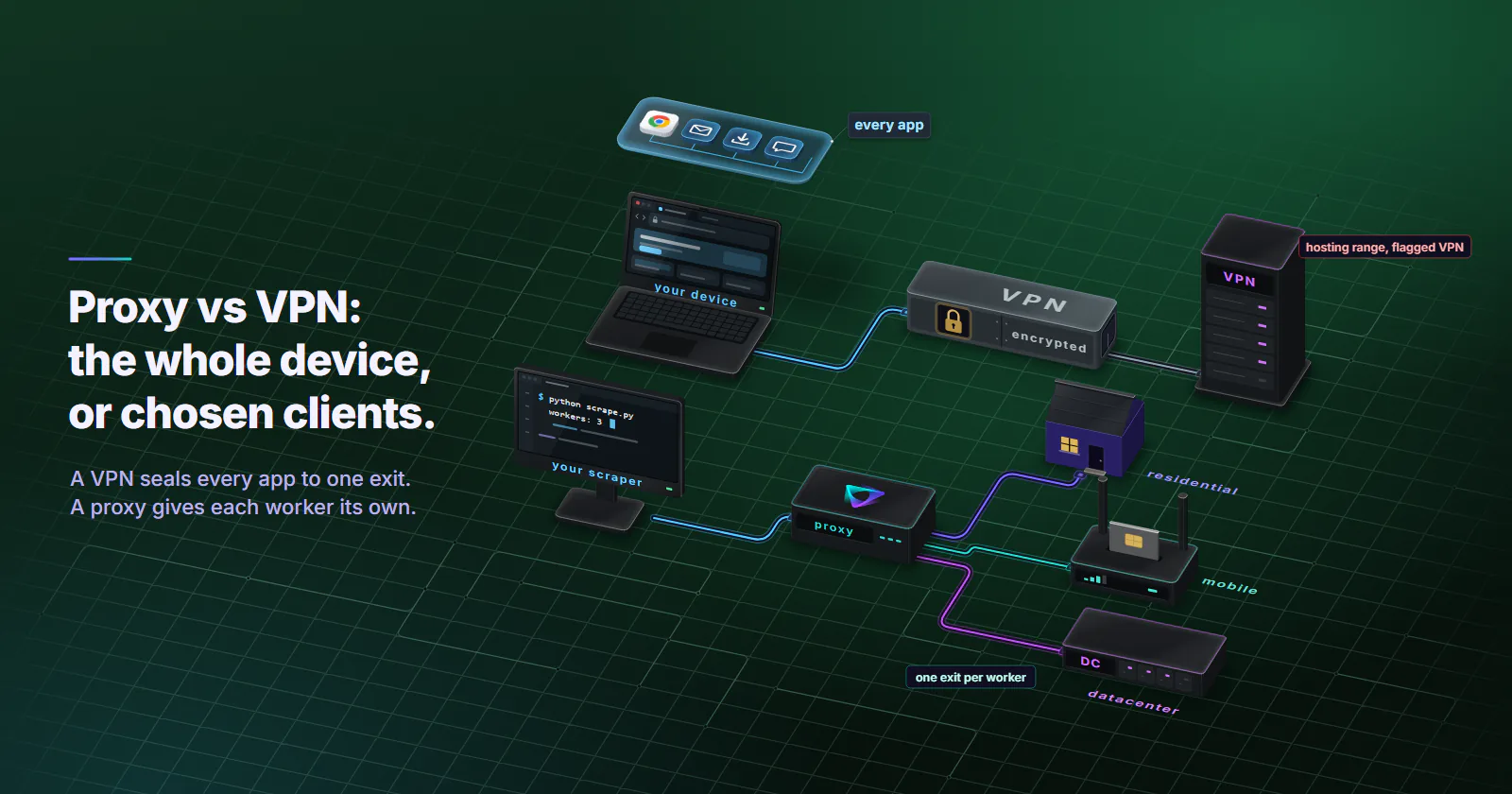
- A VPN tunnels the whole device; a proxy carries only what a client sends it. A VPN routes every app's traffic to one exit at the network layer. A proxy is set per application or per request.
- A VPN encrypts traffic to its server; a proxy protocol does not. TLS still protects HTTPS content through a proxy, but the local network can see which hosts the client connects to.
- VPN exits sit in hosting ranges and get labelled. IP intelligence services flag known VPN exits as VPN and hosting, which is why a VPN fails on targets that score ASNs.
- Neither one is reliably faster. Both add a hop. The distance to the exit and the exit's own uplink matter more than the VPN's encryption.
A VPN encrypts everything a device sends and routes it through one server, whichever app produced it. A proxy relays only the traffic a browser, scraper or other client is pointed at, and the proxy protocol encrypts nothing. So in proxy vs VPN, the VPN protects the device on its own network, and the proxy picks where the target thinks a request comes from.
The mix-up costs something both ways. A team turns on the company VPN, points a price monitor at a marketplace, and every request leaves from a hosting address the marketplace has already labelled as VPN. Someone else sets a browser proxy on a laptop in a hotel lobby and assumes the rest of the machine is covered, which it is not.
Most comparisons rank the two on “security” and conclude that a VPN wins. For personal privacy it does. For jobs where the target’s view of the request matters, only a proxy works.
Proxy vs VPN at a glance
How each one routes traffic
VPN. A VPN works at the network layer of the device. WireGuard, a common modern VPN protocol, describes itself on wireguard.com (accessed September 2026) as a tunnel that “securely encapsulates IP packets over UDP”. Its routing table is the AllowedIPs list: set it to 0.0.0.0/0 on the client and every IPv4 packet the machine sends goes into the tunnel. Browser, mail client and OS updater all leave from the same VPN exit.
Proxy. A proxy works per application, and often per request, as the middle hop described in what a proxy server is. The client has to be told to use it. For HTTPS, an HTTP proxy receives a CONNECT host:443 request and then relays bytes, which RFC 9110 (June 2022) defines as a tunnel between two connections. A SOCKS5 proxy, specified in RFC 1928 (March 1996), relays any TCP stream the same way. Anything not configured to use the proxy goes out direct, on the normal connection.
Scope is the core difference. A VPN is a device setting and a proxy is a client setting, so a scraper can run fifty workers through fifty different exits while the machine’s own traffic stays untouched.
Is a VPN a proxy?
In the loose sense that both are servers in the middle, yes. Where they capture traffic differs, and plenty of products sold as a “VPN” are proxies. Chrome’s extension proxy API (updated September 2026) lets an extension send the browser’s traffic to an HTTP or SOCKS proxy server. A browser extension that calls itself a VPN and only changes the browser’s exit is a proxy with a VPN label. Other apps on the machine stay on the normal connection. A real VPN installs a network interface at the operating system level; an extension that lives only inside the browser does not.
Apple’s iCloud Private Relay sits in between. Apple’s network guide (checked September 2026) says it carries Safari browsing, DNS queries and unencrypted HTTP from apps, over QUIC through two relays, and leaves everything else on the normal connection. That is a two-hop proxy, not a device VPN. Apple also publishes every Private Relay egress range as a CSV file, so any site can tell those visitors apart. Commercial VPN exits end up in the same kind of list, only compiled by IP intelligence vendors instead of the operator.
Encryption and what the network sees
VPN. Traffic is encrypted from the device to the VPN server. The café Wi-Fi, the hotel network or the local ISP sees an encrypted flow to one address. It does not see DNS queries, destination hostnames or plain HTTP pages, as long as they all route through the tunnel.
Proxy. HTTP CONNECT and SOCKS5 are relay protocols, not encryption. TLS inside the tunnel still protects HTTPS content end to end. But on an ordinary proxy connection, the local network can read the CONNECT example.com:443 line, and any plain http:// request travels readable to the proxy.
On an untrusted network, then, a laptop needs a VPN. A proxy configured in one browser leaves the rest of the machine exposed, and leaves the hostnames visible to the local network.
Does HTTPS replace a VPN?
Partly. HTTPS encrypts page content, with or without a proxy, so the café network cannot read passwords or pages. What it still sees is who was called: DNS lookups often go out in the clear, and the TLS handshake names the site in its server name indication field (RFC 6066) unless both sides support Encrypted Client Hello, published as RFC 9849 in 2026.
A VPN hides both from the local network, but it moves that visibility to the VPN operator, so the choice of operator matters as much as the choice of tool.
Speed: which one is faster
Neither makes a connection faster than going direct. Both add a hop: the request reaches the VPN server or the proxy first, then the target.
VPN. Every packet is encrypted on the device and decrypted on the server. With a modern protocol on modern hardware, that cost is usually small next to the route itself. The bigger effect is sharing: every app uses one tunnel, so a large OS update and a scraper compete for the same exit.
Proxy. No encryption layer of its own, so a proxy is often a little lighter per request. But the exit decides the rest. A datacenter proxy sits on a server uplink. A residential exit rides someone’s home connection, and a mobile exit rides a carrier cell. A request through either can be slower than the same request through a VPN server in the same city.
Proxy vs VPN speed has no single answer, so measure it on the job. Fetch the same URL 50 times through each with curl -w '%{time_total}\n' from the same machine, and compare the medians. Distance to the exit usually outweighs encryption.
Detection: where the exit IP sits
VPN exits sit in hosting ranges. Commercial VPN servers run in data centers, and a popular exit carries traffic from many subscribers at once. IP intelligence vendors label them. IPinfo’s privacy detection documentation (accessed September 2026) returns separate VPN, proxy, Tor, relay and hosting flags per address, and its example response for a named VPN service shows both the VPN and the hosting flag set to true. A marketplace reading that record does not need to guess.
Proxy exits are whatever tier was bought. A datacenter proxy sits in a hosting ASN too and is read the way a VPN exit is. A residential proxy exits through a consumer ISP connection, and a mobile proxy through a mobile carrier network, where CGNAT often shares one address across many subscribers.
Residential and mobile exits are not invisible either. The same documentation lists a proxy flag, and its top data tier adds a flag for addresses seen acting as residential proxies. Residential and mobile exits get flagged when the traffic through them looks automated, so the request pattern still matters; the other layers are covered in how websites detect proxies.
So for a residential proxy vs VPN decision on a scraping or account job, encryption does not decide it. The target’s ASN scoring does. If the target scores ASNs, a VPN exit is read as hosting on sight, and residential or mobile is the type built for that requirement.
Can a VPN be detected or blocked?
Yes, and usually by address alone. A site does not need to inspect the tunnel; it looks up the exit IP, sees a hosting ASN with a VPN flag, and challenges or blocks. Check the label before a job scales:
# VPN connected, no proxy set
curl -s https://ipinfo.io/json

# VPN off, request through the proxy
curl -s -x http://HOST:PORT -U "USERNAME:PASSWORD" https://ipinfo.io/json
The org field names the ASN behind each exit. Then compare the privacy flags for both addresses in the same IP intelligence service; IPinfo returns them in its Core, Plus and Max data. A hosting ASN plus a VPN flag is what a strict target reads before the first page loads.
Proxy types that change the answer
“Proxy” covers exits that behave very differently, and only some of them beat a VPN on detection. The protocol, HTTP or SOCKS5, changes which clients can use an exit, as SOCKS5 vs HTTP proxy explains. The tier changes how the target reads it.
- Datacenter. A hosting ASN, like a VPN exit, but with control: dedicated ports, one per worker, in a chosen country. Datacenter proxies are billed per IPv4 port per month.
- Rotating residential. Home ISP connections, rotation per request or sticky sessions, and city targeting. Rotating residential proxies are usage-based, per GB.
- Static ISP. One ISP-registered address, assigned to your order for the whole billing term. It is the closest proxy analogue to “one stable address”, without a VPN provider’s shared exit. Static ISP proxies are billed per IP per month.
- Mobile. Exits on mobile carrier networks, classified as cellular by MaxMind. Mobile proxies are billed per GB, built for platforms that expect a mobile origin rather than catalog scraping.
VPN or proxy for scraping
For scraping, the answer is a proxy almost every time. The job needs many exits, chosen locations, and an exit ASN the target does not score as hosting. A VPN offers one exit, in a hosting range, shared with strangers whose behaviour the target has already seen.
Rotation and concurrency settle the rest. Changing a VPN exit means reconnecting the whole device, and every app drops its sessions at once. Forty scraper threads through one VPN exit share one address with every other subscriber on it. Through a proxy, each worker or session holds its own exit and its own cookies, rotating per request or held sticky, at a rate the target allows. That leaves a tier choice: datacenter for lenient targets and API polling, residential for targets that block hosting ranges, including strict retail, and mobile for mobile-first platforms.
Where a VPN is the right tool
These jobs belong to a VPN, and a proxy is not built for them.
Personal privacy on untrusted networks. Café Wi-Fi, hotel networks, airports. A VPN encrypts every app’s traffic away from the local network. A proxy does not.
Remote access to a company network. Reaching internal dashboards, databases or file shares is what corporate VPNs exist for.
Software that ignores proxy settings. Some desktop apps, games and system services never read proxy settings. A network-layer tunnel is the only way to route them.
One stable address for a person. Someone who wants the same exit for browsing, mail and messaging all day is better served by a VPN. A VPN is a flat subscription for one person’s traffic; proxies are billed per GB, per IP or per port for traffic a business moves on purpose.
Using a proxy and a VPN together
The path is device, then VPN server, then proxy, then target. The local network sees only the VPN tunnel. The VPN operator sees connections to the proxy host. The target sees the proxy’s exit.
A common setup: the whole machine runs on the company VPN for internal systems, and the scraper points at a proxy. The cost is latency, because each request makes two hops before it reaches the exit. If that matters, split tunnelling can send the scraper’s traffic straight to the proxy. Someone who already has a VPN needs a proxy only when the job needs exits the VPN cannot give.
Risks both tools share
Leaks. A client that resolves hostnames locally sends DNS lookups outside the proxy, a proxy DNS leak, and sometimes outside the tunnel. Browsers also run WebRTC, which can reveal the real public address to page scripts over UDP. A proxy set only for HTTP does not carry that traffic.
Fail-open. When a VPN drops without a kill switch, traffic falls back to the normal connection. When a proxy fails, most clients return an error, but a scraper with a “retry direct” fallback leaks the server’s own address.
Free services. A 2024 study of free proxies (arXiv, March 2024) followed more than 640,600 proxies from 11 providers over 30 months. Only 34.5% were active even once, and 16,923 manipulated content. Free VPNs raise the same question: someone pays for the servers.
Trust. Both tools move visibility from the local network to an operator. Pick one with a written logging policy and a clear account of where its exits come from.
Proxy vs VPN: the decision rule
Settle proxy vs VPN by what has to change: the device’s exposure to its own network, or the target’s view of where a request comes from.
- Protect one device on an untrusted network. Use a VPN, which encrypts everything to the VPN server and covers apps that ignore proxy settings.
- Reach a company network. Use the company’s VPN.
- Send many requests from chosen locations that a target accepts. Use a proxy, on the tier the target’s ASN scoring allows.
- Both apply. Run both: the VPN protects the machine and the proxy picks the exit the target sees.
When neither the device nor the target’s view needs to change, neither tool is needed.
Frequently asked questions
A VPN routes all of a device's traffic through an encrypted tunnel to a VPN server, whatever application produced it. A proxy only carries the traffic a specific client is configured to send to it, and the proxy protocol itself does not encrypt anything. A VPN changes how the device's own network sees it, while a proxy mainly changes which address and location the target sees.
For privacy on public Wi-Fi or another untrusted network, yes, because a VPN encrypts every app's traffic to the VPN server. For scraping, geo checks and other jobs where the target scores the exit IP, a proxy is better, because it offers many exits, chosen locations and non-hosting address types. Both still require trusting whoever runs the server.
Not reliably. A proxy skips the VPN's tunnel encryption, but both add a hop, and the exit decides most of the speed. A datacenter proxy is usually quick, while a residential or mobile exit rides a home or carrier connection and can be slower than a VPN server in the same city.
For protecting a device, a VPN, because it encrypts every app's traffic from the device to the VPN server, while the proxy protocol encrypts nothing and covers only clients configured to use it. Neither is safer than its operator: both move visibility from the local network to whoever runs the server, so a written logging policy matters for either.
For reaching targets that score IP addresses, usually yes, because a residential proxy exits through a consumer ISP connection while VPN exits sit in hosting ranges. For personal privacy it is the wrong tool, since it does not encrypt traffic and only covers clients configured to use it. Residential exits can still be flagged when the traffic through them looks automated.
A proxy, in almost every case. Scraping needs many exits, chosen locations and rotation, and ideally exits that the target does not classify as hosting. A VPN offers one exit per tunnel, usually in a data center range that IP intelligence services label as VPN, so targets with anti-bot scoring block it quickly.
Yes. With the VPN active, the connection from the client to the proxy travels inside the VPN tunnel, and the target sees the proxy's exit address. The local network sees only the VPN tunnel. The cost is latency, because every request makes an extra hop before it reaches the proxy exit.
Researched and drafted with AI tools, then checked against our publishing rules before it went live: 8 outside links, 8 links to other proxymint pages, no prices and a fact-check pass against our product records. How we write.