ASN targeting vs geo targeting: what each one selects
ASN targeting vs geo targeting: one picks the network behind an IP, the other its place. When each matters, and how to verify an exit's ASN and location.
Quick summary · TL;DR
- An IP carries two facts. Geolocation says where it is; the ASN says whose network announces it. ASN targeting selects on the second, geo targeting on the first.
- Most network checks read the ASN type, not the ASN. Ad-fraud filters and hosting rules ask what kind of network an IP sits on, so the proxy type you choose matters more than a named ASN.
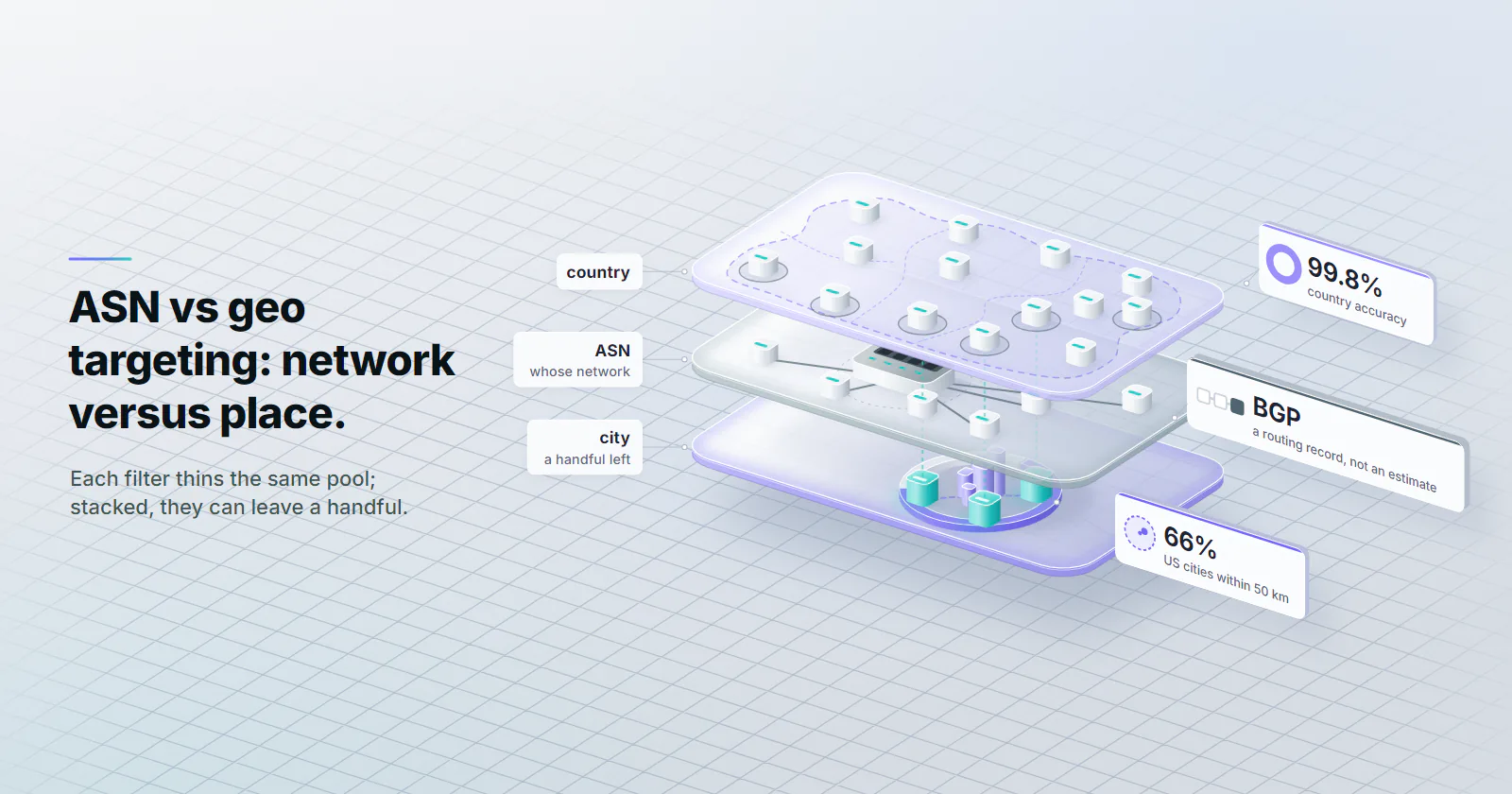
- Geolocation gets vaguer as it gets finer. MaxMind estimates 99.8% country accuracy but 66% for US cities within 50 km (checked September 2026), and each target runs its own database.
- ASN targeting narrows the pool hard. One network in one country, and a city on top, can leave a handful of exits or none.
- proxymint targets by country, region and city. It does not sell ASN or carrier selection; the specific ASN matters mainly for carrier-only content and ISP-specific testing.
ASN targeting vs geo targeting is network versus place. ASN targeting picks proxy exits by the network that announces them, such as one broadband ISP or one mobile carrier; geo targeting picks them by where an IP geolocation database places them. Targets read both, but most network checks key on the type of network, so the proxy type matters more than a named ASN.
A team planning a carrier-billing test asks for ASN targeting. Another team checking local prices asks for city targeting. The first job depends on one network, the second on one place, and most jobs depend on neither as tightly as the filter suggests. A one-minute lookup of the exits a job uses shows both facts.
What ASN targeting selects
An Autonomous System is, in the words of RFC 1930 (March 1996), a connected group of IP prefixes run by one or more network operators with a single, clearly defined routing policy. Every consumer ISP, mobile carrier, cloud provider and university runs one or more of them, and each has a number. Look up any IP and the ASN tells the target who announces it.
Filtering by that number means only this ISP, only that carrier. An ASN proxy offer sells exits filtered to one network.
ASN or ISP targeting. ISP targeting is the same filter sold under a friendlier name. The one difference is scope. A large operator often runs several ASNs, one inherited from each acquisition or separate ones for its fixed and mobile networks, so “target this ISP” can mean a group of numbers while an ASN filter names exactly one.
ASN type versus ASN identity. Most targets care about the category of the network far more than the specific operator. IP data vendors classify ASNs into types; the IPinfo ASN database (updated October 28, 2025) uses five: ISP, hosting, education, government and business. A rule written against hosting ASNs is a type check. It does not care which broadband provider a home exit sits on.
ASN targeting vs geo targeting
The two filters answer different questions. Geo targeting answers “where does this IP appear to be”, the question geo targeted proxies are sold on. ASN targeting answers “whose network is this”. They also fail differently, because one answer is an estimate and the other is a routing record.
What IP geolocation tells a target
IP geolocation answers “where”, and its accuracy drops fast as the question gets finer. MaxMind’s accuracy notes (checked September 2026) estimate 99.8% accuracy at country level, around 80% at state or region level for US IPs, and 66% for US cities within 50 km. The same page flags lower confidence for mobile networks, where one IP range can serve phones across a large area, and says such IPs may resolve only to country and state.
Why databases disagree. Each geolocation vendor builds its map from different inputs: registry records, operator-published feeds, latency measurements and user-submitted corrections. Two databases can place the same IP in different cities while agreeing on the country. The target uses its own vendor, so the location a proxy provider advertises and the one the target computes are not guaranteed to match below country level.
Why ASN data is steadier. An ASN comes from routing: the network that announces the prefix in BGP. It changes when a prefix is sold or re-announced, not because a database guessed a city. So the question “is this a hosting network?” usually gets a firmer answer than “is this in Leeds?”.
Country, city or ASN
In ASN vs location terms, location is an estimate that gets vaguer as it gets finer, and ASN type is a fairly hard fact about the network. Here are the three common filters side by side.
Stacking filters multiplies the thinning. City plus ASN keeps only the exits that sit on one network and carry one city label at the moment of the request, which in a smaller city can be a handful of devices.
Which checks read which fact
Each common target behaviour keys on one of the two facts, or both, as inputs to the scores described in how anti-bot systems work. This table is built from how each check works, not from a measurement of specific sites.
The ad industry makes the ASN-type check explicit. The Media Rating Council’s invalid traffic standards addendum (June 2020 update) treats known invalid data-center traffic as general invalid traffic and requires accredited measurers to filter invalid data-center traffic from IPs of the three largest hosting entities: Amazon AWS, Google and Microsoft. That is a network-type rule: it reads the type, not a named network.
Only one row needs the specific ASN: content or billing tied to one carrier. Everything else is answered by location, by ASN type, or by both. More on how the network type shapes trust is in the posts tagged ASN reputation.
When the specific ASN matters
ASN identity matters in a short list of permitted jobs:
- Carrier-specific experiences. Zero-rated content, carrier billing flows and carrier portals behave differently on one operator’s network. Testing them needs that operator’s IPs.
- ISP customer experience testing. An ISP checking what its own subscribers see, or a CDN team debugging routing to one network, needs exits on that ASN.
- Partner allowlists by network. Some B2B services allow a named ISP’s ranges only.
Outside these, the type of network matters more than the named network, and the proxy type answers that. For a job tied to one named carrier or ISP, a test device on that network is the direct route.
ASN targeting tradeoffs
The filter has costs even where it is on sale.
Thin pools. An ASN filter keeps only the exits on one network in the chosen country. Add a city and the candidates can drop to a few devices, or to none at 4 a.m. local time. On services that sell the flag, that shows up as “no IP available” errors or long waits for a new exit.
Shorter sessions. With few candidates, a sticky session that loses its device has little to fall back on.
Verify an exit’s ASN and location
Before paying for any filter, look up who announces the exits a job uses. Team Cymru runs a free IP to ASN mapping service (checked September 2026) over whois and DNS. One query returns the origin ASN, the announced prefix, the registry country and the network’s name.
# The exit IP the target sees, asked through the proxy itself
curl -s -x http://HOST:PORT -U "USERNAME:PASSWORD" https://api.ipify.org

# One IP: origin ASN, prefix, registry country, allocation date and AS name
whois -h whois.cymru.com " -v EXIT_IP"

# Many IPs: put one per line in exits.txt, then run a bulk query
printf 'begin\nverbose\n%s\nend\n' "$(cat exits.txt)" | nc whois.cymru.com 43
Read the AS name for the type. A cloud or hosting company name points to a hosting ASN; a broadband or mobile brand points to a consumer one. An ASN database with an explicit type field, such as IPinfo’s, removes the guesswork for a long list.
The registry country is not the location. The country in the lookup comes from the regional registry that allocated the block, and the same service page warns it is not a geolocation result. An address registered to a German company can be used in Austria. For “where”, query a geolocation database separately.
Check each exit before the job
- Echo the exit. Ask an IP echo service through the proxy, as above, and log the address the target will see.
- Look up ASN and type. Run the IP through the lookup and note whether the network is typed ISP, hosting, business or education.
- Look up location twice. Check the country and city in two geolocation databases. If they disagree with each other or with the market the job needs, step up to the coarsest level that gives the right answer.
- Check the proxy scheme. With plain
socks5://your own resolver answers DNS, so a host that steers by resolver can serve the wrong region. On proxymint’s per-GB gateway, HTTP CONNECT andsocks5h://resolve names on the proxy side (our US test exits used US public resolvers). - Record the result per exit. Note the ASN, type, country and city next to each exit, so the job’s results can be read against the network and place that produced them.
The five steps take minutes and settle the question before anything is bought. If the target blocks the job, that is its answer: stop, and check its terms or an official API. Changing the network to get past the block is not the fix.
Proxy tiers and their ASN types
The tier decides the ASN type, and the location control decides the geolocation.
- Datacenter proxies on IPv4 ports sit on hosting ASNs and fit targets that do not filter by network type, such as APIs, monitoring and your own sites. IPv4 ports are chosen by country. The datacenter proxies guide covers the category.
- Static ISP proxies use ISP-registered addresses, assigned to your order for the whole billing term and chosen by country. How they differ from datacenter ports is covered in ISP vs datacenter proxies.
- Rotating residential proxies exit from home connections on broadband networks, with country, region and city from live supply.
- Mobile proxies exit on addresses classified as cellular by MaxMind, with country, region and city targeting, and no carrier selection.
ASN and geo targeting together
Keep ASN vs location straight when planning a job. A job that depends on where needs geo targeting at the coarsest level that gives the right answer, checked in a second database before it scales. A job that depends on the kind of network needs the right proxy type: account work fits a static ISP address, collection of public pages fits residential, machine-facing work fits datacenter. A job tied to one named carrier or ISP is the one case where the ASN itself matters, and a test device on that network is the direct route. A block is not a targeting problem: the job stops, because a different ASN or location is not the answer to it.
For most jobs, ASN targeting vs geo targeting is a choice of place plus a proxy type, not a named network.
Frequently asked questions
ASN targeting means choosing proxy exits by the Autonomous System Number of the network that announces them, for example only one broadband ISP or one mobile carrier. It narrows the pool to a single network. It is useful when a job depends on that specific network and rarely helps otherwise.
Yes, in practice. ISP targeting is the friendlier name for the same filter: exits limited to the address ranges one operator announces. The difference is that a large operator often runs several ASNs, so ISP targeting may cover a group of numbers while ASN targeting names exactly one.
Geolocation estimates where an IP address is, from country down to city, using a database. The ASN identifies which network announces the address in internet routing. A target reads geolocation for things like local prices and licensing, and reads the ASN type for things like ad-fraud filtering and network rules.
Query a public IP-to-ASN service such as Team Cymru's whois service, or any ASN lookup page, with the IP. It returns the origin ASN, the announced prefix, the network name and the registry country. The registry country is not a geolocation result, so check location separately in a geolocation database.
Some do, mostly by ASN type rather than by a named network. Ad measurement is the documented case: the Media Rating Council's 2020 invalid traffic standard requires accredited measurers to filter invalid data-center traffic from the largest hosting providers. Site operators can also write firewall rules on ASNs. If a site blocks a job, that is its answer: stop, and use the site's API or check its terms.
ASN targeting matters more when the content or flow depends on one network: carrier billing, zero-rated content, carrier portals, an ISP testing its own subscribers' experience, or a partner that allowlists one ISP's ranges. City targeting matters more for local search results, local stock and local ads. For most monitoring and price checks, country level and the right proxy type are enough.
On proxymint, mobile proxies are targeted by country, region and city from live supply, and the carrier is whichever network the device in that location uses; mobile exits are classified as cellular by MaxMind. Residential is also targeted by place, and ISP proxies and datacenter IPv4 ports by country. For a job tied to one named carrier, a test device on that network is the direct route.
Researched and drafted with AI tools, then checked against our publishing rules before it went live: 5 outside links, 9 links to other proxymint pages, no prices and a fact-check pass against our product records. How we write.