ISP vs datacenter proxies: which job each one fits
ISP vs datacenter proxies: both run on servers and hold one IP for the term. Which job each one fits, how speed compares, and how each is billed.
Quick summary · TL;DR
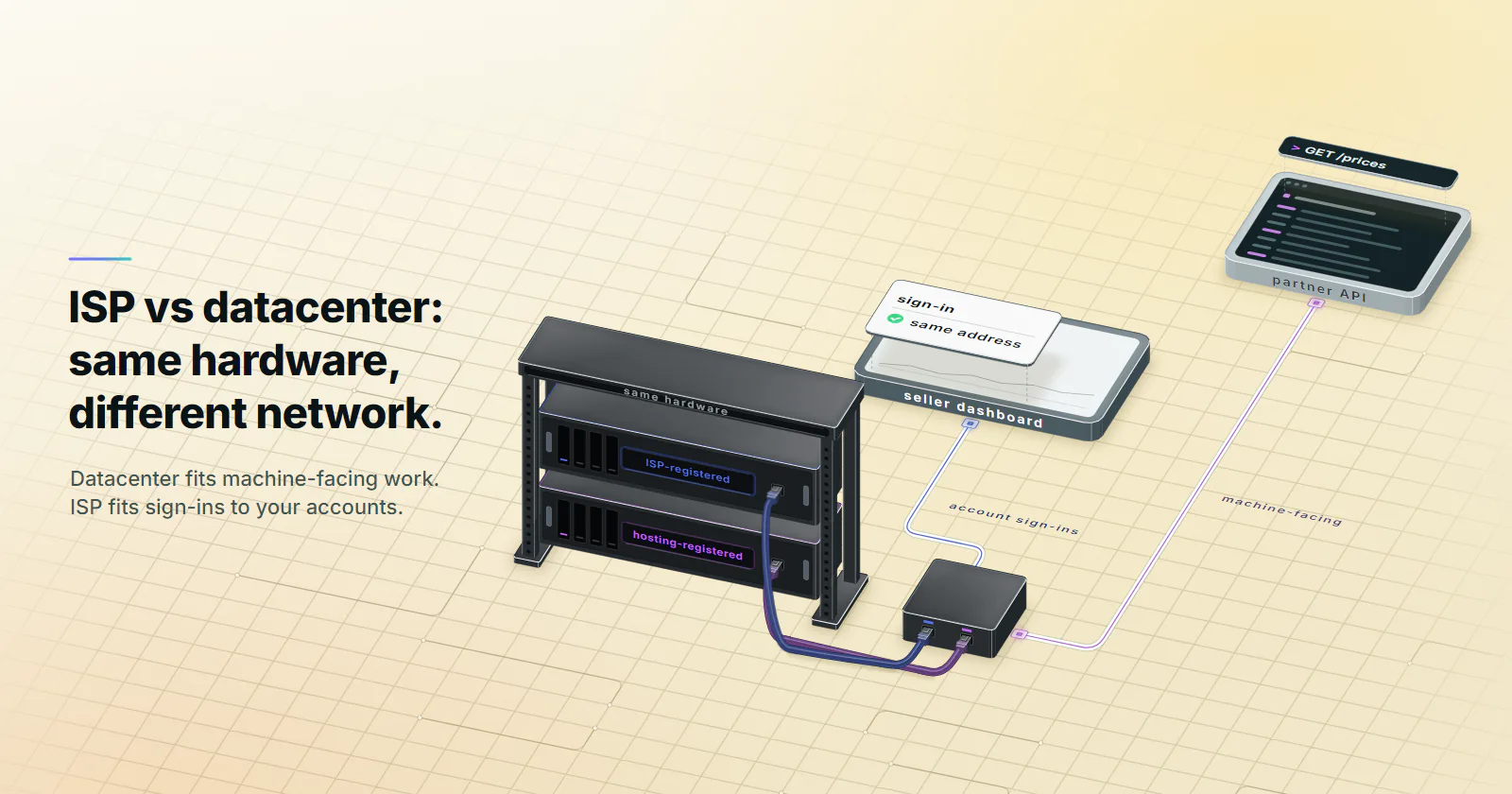
- Same hardware, different registered network. ISP proxies and datacenter proxies both typically run on servers and both hold one fixed address, assigned to your order for the whole billing term. A datacenter IP is registered to a hosting company, an ISP proxy's IP to an internet service provider.
- Datacenter fits machine-facing work. APIs, monitoring, lenient public sites, internal tools and load tests expect servers, and a datacenter port is built for them.
- ISP fits account work. Sign-ins and accounts the team owns or runs for clients need one steady address held for weeks, and an ISP-registered address fits that job.
- Speed does not decide it. Neither type routes through a home connection, so latency depends mostly on the path between exit, target and client. Measure it on the real target.
- Both bill per address, per month. Datacenter per port, ISP per IP, neither metered per GB.
ISP vs datacenter proxies differ in who the IP is registered to, not in the hardware. Both hold one fixed IP, assigned to your order for the whole billing term, usually on servers. A datacenter IP is registered to a hosting company; an ISP proxy’s IP is registered to an internet service provider. Datacenter fits APIs, monitoring and your own tools; ISP fits sign-ins to accounts the team owns.
A team runs two jobs. One polls a partner API every five minutes for price updates. The other is a seller dashboard that three people sign in to every day. The first is machine-facing and fits a datacenter port. The second is account work that needs one address, held for weeks. Most fleets have both kinds of job, and that split is the decision this comparison is about.
ISP vs datacenter proxies, defined
Datacenter proxies. A server in a hosting facility, on an address block that belongs to the hosting company. The block is announced by that company’s ASN, so a lookup returns a cloud, a colocation provider or a server host. proxymint’s dedicated IPv4 ports are this product: one address per port, billed monthly, with no per-GB traffic meter. What the dedicated label means next to shared pools is covered in dedicated vs shared proxies.
ISP proxies. Also a server in most setups, with the same fixed address for the term. The difference is upstream of the server: the address is registered to an internet service provider, not to the hosting company that runs the machine. On proxymint each ISP IP comes with its own username and password and an HTTP and a SOCKS5 port, chosen by country, not metered per GB. The ISP proxies guide goes further into how those ranges come about.
So are ISP proxies datacenter proxies? Physically, often yes. The difference is whose network the address is registered to, and that decides which jobs each one fits.
What the network type changes
The ASN type registry. IP data vendors do not stop at recording which network announces an address. They classify the network. The IPinfo ASN database (updated October 28, 2025) files every ASN under one of five types: ISP, hosting, education, government or business. Hosting ASN vs ISP ASN is one field in that record, and any service can read it.
Reading the network behind an address takes one query. Team Cymru’s free IP to ASN mapping service (checked September 2026) returns the origin ASN, the announced prefix, the registry country and the network’s name:
# The exit IP the target sees, asked through the proxy itself
curl -s -x http://HOST:PORT -U "USERNAME:PASSWORD" https://api.ipify.org

# Origin ASN, prefix, registry country, allocation date and AS name
whois -h whois.cymru.com " -v EXIT_IP"
The AS name shows which kind of company announces the block. For the type itself, read a database with a type field, such as IPinfo’s.
Some services key rules on it. The ad industry writes this down. The Media Rating Council’s invalid traffic addendum (June 2020 update) classes known data-center traffic as general invalid traffic in ad measurement, filtered by lists, at minimum for the three largest hosting entities: Amazon AWS, Google and Microsoft. Site operators can write a similar rule by hand. Cloudflare’s challenges troubleshooting guide (updated May 5, 2026) uses a firewall rule on ASNs 16509 and 15169, AWS and Google Cloud, as its worked example.
What that means for fit. Machine-facing work talks to services that expect servers: an API that authenticates by key, a monitor, your own staging site. There the network type is not part of the decision, and a datacenter port is the fit. Account work is different. A platform compares each sign-in with the last one, so the account needs one steady address, and an address registered to an ISP, held for the whole term, fits that job.
Speed, sessions and pool size
Speed tops most comparison tables for this query, and it is the weakest axis to decide on.
Speed. Both types usually run on server hardware in a facility, with no home router or mobile device in the path. So neither is reliably faster by category. Latency comes mostly from distance: client to proxy, proxy to target. A datacenter exit in the target’s country will beat an ISP exit on another continent, and the reverse holds too. Any “3x faster” line without a method is marketing. Measure it:
# Time to first byte through one proxy, 20 runs
for i in $(seq 1 20); do
  curl -s -o /dev/null -w "%{http_code} %{time_starttransfer}\n" \
    -x http://HOST:PORT -U "USERNAME:PASSWORD" https://TARGET_URL/
done
Run it through an ISP IP and a datacenter port in the same country and compare the median and the slowest runs. Read the status code next to each time: a 403 or a challenge page is the target’s answer and a stop signal, not a speed result.
Sessions. Both hold one address for the whole term, so neither rotates on its own. proxymint’s ISP IPs carry no rotation at all: the address is the product. A cookie tied to one IP survives on either type.
Pool size and location. Hosting space is plentiful across the market, so datacenter supply in a given country is rarely the constraint. ISP ranges are smaller across the market, so expect a shorter country list on ISP than on datacenter from most providers. One more point applies to both: addresses often arrive in contiguous blocks, and a target that blocks a range blocks every address in it.
When each one fits
When datacenter proxies fit
A large share of proxy work is machine-facing. For these jobs, datacenter proxies are the fit; where residential exits come in instead is covered in datacenter vs residential proxies.
- APIs. Public and partner APIs authenticate by key and expect machine traffic. The ASN is not part of the decision.
- Lenient sites. Catalogs, documentation, public data portals and any target that publishes its data for collection.
- Monitoring. Uptime checks, API polling, and checks of your own sites from another country.
- Internal tools. Your own staging, admin panels and firewall allowlists. A partner firewall works the same way: a fixed address is a fixed address, unless the partner asks for a specific network type.
- Load testing. Many addresses, heavy traffic on your own systems.
When ISP proxies fit
Account work is the other half: one login, one address, for weeks.
- Accounts the team owns or runs for clients. Posting, messaging and managing social and marketplace accounts, with the owner’s permission.
- Sign-in flows. Seller dashboards and ad accounts. Login risk scoring reads a change of network as a new risk signal, so one steady address keeps the account on familiar ground.
- Long-lived sessions. Any job where one address has to hold for weeks, such as a partner integration that allowlists a single IP registered to an ISP.
This is the ground static ISP proxies are built for: one ISP-registered address, assigned to your order for the whole billing term, so the account sees the same address every day. For collection that needs thousands of different IPs, rotating residential is the fit; for app-first accounts, see mobile vs ISP proxies.
ISP vs datacenter proxies: how each is billed
Both bill per address, per month, and the rate falls as the order grows; rates are on the pricing page. Datacenter bills per port and ISP per IP, and neither is metered per GB. ISP IPs can be held month to month or on 3- and 12-month terms.
The billing unit rarely changes the answer. The deciding question is what the job needs.
Using both together
A fleet with mixed jobs does not have to pick one type. Route each job to the type it fits.
A team with 100 addresses where only 20 face sign-in flows can put those 20 on ISP and the other 80 on datacenter ports, and keep each job on the type it fits. The split only works if the halves stay apart:
- Route by job list, not by habit. Keep one list of jobs that sign in to accounts and send only those through ISP.
- One config per type. Separate credentials and job configs, so a retry never falls back from an ISP address to a datacenter port.
- Never mix on one account. An account that has logged in from an ISP address should not see a different network on its next sign-in.
- Re-check when a job changes. A job that starts signing in to an account moves to the ISP list.
Datacenter or ISP proxy: the rule
In ISP vs datacenter proxies, decide per job, not per team.
- If the job talks to an API, a lenient site, a monitoring endpoint or your own tool, use datacenter. It is built for machine-facing work.
- If the job is a sign-in flow or an account the team owns, use ISP.
- If one fixed address has to hold an account for weeks, use ISP. If the job needs thousands of different IPs, use rotating residential proxies instead.
- If only part of the fleet faces sign-ins, split it.
Answering datacenter or ISP proxy for a new job takes four questions before any order. Does it sign in to an account? Does one address have to hold for weeks? Does the other side expect a server? Does it need many different addresses? Then run the time-to-first-byte loop from both types in the same country to size the path. A challenge from a target is a stop signal, not a reason to change tier. More on how network type shapes trust is in the posts tagged ASN reputation.
Frequently asked questions
Both hold one fixed IP address, assigned to your order for the billing term, and both usually run on server hardware. A datacenter proxy uses an address registered to a hosting company, while an ISP proxy uses an address registered to an internet service provider. Datacenter fits machine-facing work such as APIs, monitoring and internal tools; ISP fits sign-ins and accounts that need one address held for the term.
Usually, yes. ISP proxies are typically servers whose addresses are registered to an internet service provider rather than to the hosting company. They hold the same fixed address for the term as a datacenter port; the difference is whose network the address belongs to.
Neither is reliably faster. Both usually run on server hardware with no home connection in the path, so latency depends mostly on the distance between the exit, the target and the client. Measure time to first byte through one address of each type against the real target before assuming a gap.
Both are billed per address, per month: datacenter per port, ISP per IP. Neither is metered per GB, and the rate falls as the order grows. On proxymint, ISP IPs can be held month to month or on 3- and 12-month terms, and the rates for both are on the pricing page.
When the job signs in to accounts the team owns or runs for clients, or needs one address held for weeks. Account platforms compare each login with the last one, and a steady ISP-registered address fits that work. APIs, monitoring, lenient sites, internal tools and load tests are machine-facing, and a datacenter port fits them.
It is the type an IP data vendor gives the network that announces an address. IPinfo's ASN database files every ASN under one of five types: ISP, hosting, education, government or business. A hosting ASN belongs to a cloud, colocation or server company; an ISP ASN belongs to an internet service provider. Some services key rules on that field, which is why it shapes the jobs each proxy type fits.
Yes, and a mixed fleet is often the cleanest setup. Put the addresses that face sign-ins on ISP, and route APIs, monitoring and lenient sites through datacenter ports. Keep the two in separate job configs so no account ever logs in from a datacenter port.
Researched and drafted with AI tools, then checked against our publishing rules before it went live: 4 outside links, 9 links to other proxymint pages, no prices and a fact-check pass against our product records. How we write.