Multiple Amazon seller accounts: what Amazon allows and how
Amazon allows extra seller accounts only for a legitimate business need. What counts, what each account needs, how teams log in, and where a static IP fits.
Quick summary · TL;DR
- Amazon allows it with a legitimate business need. One Seller Central account per region is the default. Extra accounts are allowed when there is a real business reason and every account is in good standing.
- There is no approval form. Amazon staff have said since 2022 that the seller self-assesses the need. Other regions can differ, so read that region's Seller Central rules.
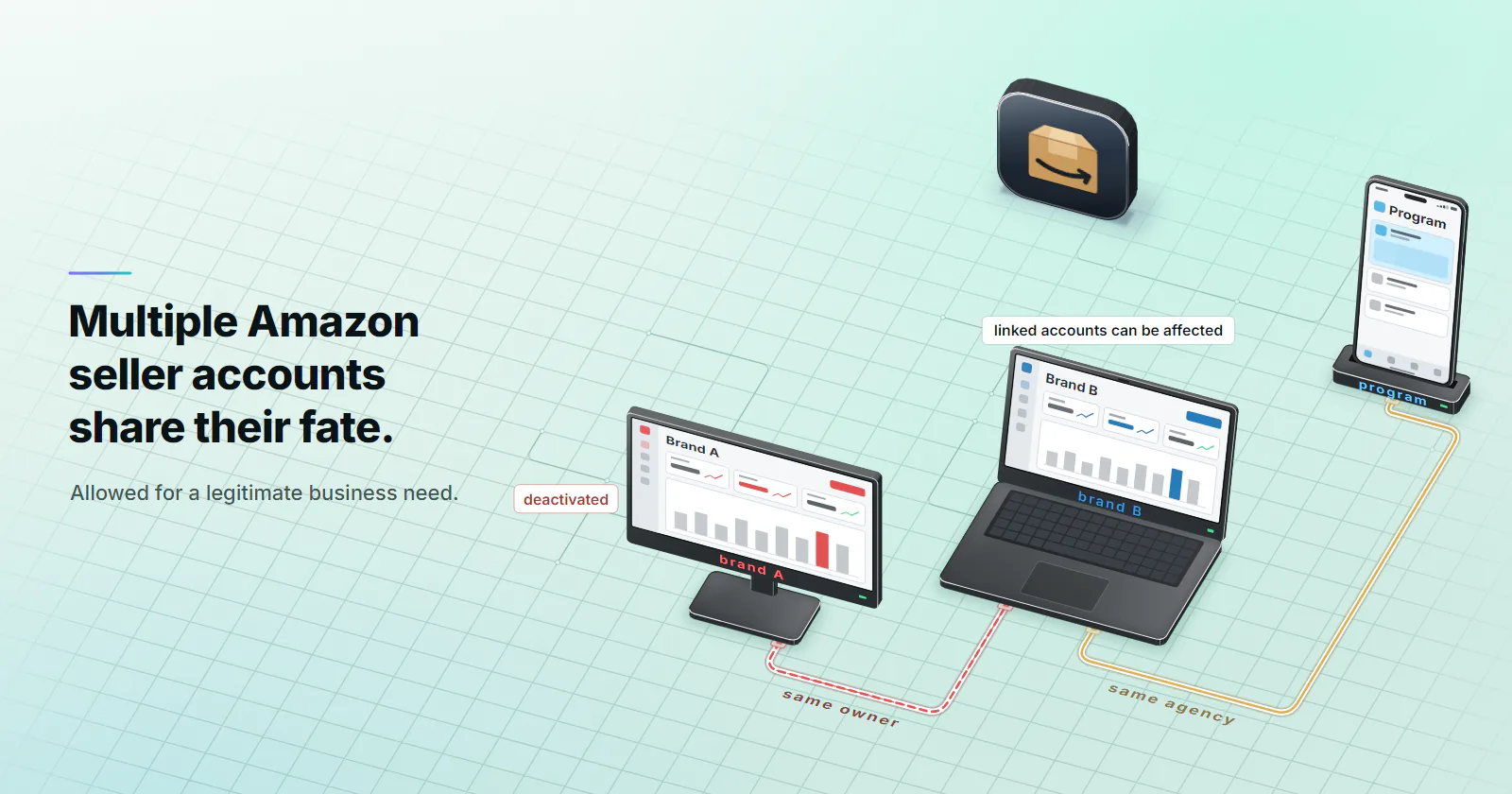
- Associated accounts share their fate. One deactivation can affect every account linked through people, services or business details. Keep every one of them in good standing.
- Staff and agencies use User Permissions. Each person gets their own login with two-step verification. Nobody shares the owner's password.
Yes, Amazon allows multiple Amazon seller accounts, but only when there is a legitimate business need and every account is in good standing. In the US, no approval request is needed: the seller judges the need and answers for it. The Seller Code of Conduct names three examples: separate brands run as separate businesses, manufacturing for two distinct companies, and an Amazon program that requires its own account.
The question rarely arrives that cleanly. A founder launches a second brand under a new company. A husband and wife each run an LLC from the same house. An agency takes on its sixth client.
Each case has an answer in Amazon’s own rules, and none of them starts with an IP address.
Multiple Amazon seller accounts: the rules
What Amazon’s rules say
The rule sits in the Seller Code of Conduct (Seller Central help page G1801). Amazon’s own published copy of it (the Selling Policies and Seller Code of Conduct PDF, checked 2026-09-29) says a seller may only maintain one Seller Central account for each region “unless you have a legitimate business need to open a second account and all of your accounts are in good standing.” The next sentence carries the penalty: if any account is not in good standing, Amazon may deactivate all of them until every one is.
It lists three examples of a legitimate business justification:
- The seller owns several brands and runs a separate business for each.
- The seller manufactures products for two distinct and separate companies.
- The seller was recruited into an Amazon program that requires a separate account.
The examples are not a closed list. In each one, the second account belongs to a real, separate business with its own reason to exist.
Amazon staff have filled in the rest on the Seller Forums. A community manager wrote in a 2022 thread (checked 2026-09-29) that Amazon no longer requires sellers to get approval for multiple selling accounts, and that Amazon cannot make the legitimacy call for a seller. So the seller self-assesses. A staff reply in a 2024 thread (checked 2026-09-29) repeats that sellers with a legitimate business need may operate multiple accounts without prior approval. Forum posts are staff explanations of the policy, and one shorter 2025 staff summary still mentions “proper approval”. When they disagree, the Code of Conduct wording above is what binds.
There is no approval form to fill in for the US store, and Amazon publishes no account limit. Guides that date the rule to a “2020 policy update” point readers at history; the current Code of Conduct is linked above.
The staff answers are about the US store. A seller in India, Japan or Europe should read that region’s Seller Central first.
What does not count as a legitimate need
The “yes” rows are the examples in G1801. The “no” rows follow from the rule itself and from the staff posts cited in this guide.
| Reason for another account | Counts? | Why |
|---|---|---|
| A second brand run as its own business | Yes | Named in G1801 |
| Manufacturing for two distinct companies | Yes | Named in G1801 |
| An Amazon program that requires a separate account | Yes | Named in G1801 |
| Getting around a suspension, restriction or listing limit | No | The account exists to escape a decision made on another one |
| The same products or ASINs listed from two accounts for more Buy Box or search share | No | One business, twice, competing against itself on the marketplace |
| Splitting one business for cleaner reports | No | Reporting is a tooling problem, not a business need |
| Giving staff or an agency their own access | No | That is what User Permissions is for |
| A new account while a related one is deactivated | No | Per Amazon staff, the original account has to be reinstated first |
The last row is the hard line. Opening a fresh account while a related one is deactivated is itself a violation.
How Amazon links related accounts
Amazon treats accounts that share people, services or business information as related, or associated. Per the 2024 staff reply, association runs through the people who access the accounts (owners and employees), through third-party services that manage several accounts, and through shared business information.
What follows from association, per the same reply:
- If one associated account is deactivated for a policy violation, selling privileges on all associated accounts can be affected.
- The original account has to be reinstated before the others recover.
- An account can only be closed once every associated account is in good standing.
A 2025 staff summary (checked 2026-09-29) says the same in fewer words: one account per region unless there is a legitimate business need, every account in good standing, and issues with one account may affect all linked accounts.
For a legitimate second business, association is expected. The same founder owns both companies, the same accountant files both returns, and Amazon can see that. That is fine.
Guides that promise to keep Amazon from connecting two accounts protect against nothing that matters here. One account falling out of good standing can still take the others with it.
One account or several
A second account is not automatically the safer structure. It helps with some things and changes nothing about policy risk.
So separate accounts keep operations apart and make a brand easier to sell. They do not contain policy risk. A seller who opens multiple Amazon seller accounts hoping to shield one brand from another’s mistakes has misread how association works.
Regions, marketplaces and second accounts
The rule is one account per region, and a region can hold several countries. Amazon’s Global Selling page (checked 2026-09-29) describes a North America and Brazil unified account that reaches the US, Canada, Mexico and Brazil, and a Europe account for the European stores. A business expanding inside a region adds marketplaces to the account it already has. It does not open a second account in the same region for the same business.
“Expanding to different countries” appears on ranking pages as a reason for another account. For the same business inside one region, it is not one. Some stores, such as Japan, Australia and India, sit outside those unified accounts, and the list can change, so check Global Selling before planning an expansion around it.
The same logic applies to brands. Two brands run by one company can sit in one account. A second account becomes an option when the second brand is run as its own business, with its own entity, books and people.
What each account needs
Each account carries the identity of the business behind it. The checklist separates what must differ because the businesses are different, what can be shared honestly, and what nobody should ever invent.
- Legal entity. Each account is its own business, which can share an owner or directors with the first but is never a company with no business behind it.
- Tax ID. Usually one per business, with an Amazon program account as the possible exception, and never someone else’s number.
- Payout bank account. The business’s own account, shared with nothing, never a borrowed or third-party one.
- Credit card on file. A card in the business’s name, shared with nothing, never one belonging to someone outside the business.
- Primary admin email. One per account, on a shared domain only if both businesses really use it, and always a real person or role.
- Phone number. Usually its own, a shared office line only if that is the truth, and never a number the business does not actually use.
- Business address. The business’s real address, which can be the same home, office, accountant or warehouse, and never an address the business does not use.
Artificial differences, such as invented addresses, borrowed identities or numbers bought to look separate, are themselves the violation. A shared household or a shared accountant is a fact Amazon can see and a legitimate business can live with. A fabricated detail is a false statement on a verified account.
Entity structure and tax registration are questions for an accountant or lawyer.
How to open a second account
- Register the new business first. The entity, tax registration, bank account and card should exist in the business’s own name before the Seller Central sign-up.
- Sign up with the new business’s details. Its own legal name, tax ID, address, email and phone. The owner can be the same person as on the first account; the business details are the new business’s.
- Pass identity verification. Amazon verifies the person and the business behind each account. Use real documents for the new business.
- Set up two-step verification. Amazon has required it for every Seller Central sign-in since March 2024, per its announcement in the Seller Forums. Tie the primary login to a phone or authenticator app the new business controls before anyone else is invited.
- Enroll the new brand in Brand Registry if it has its own trademark, from the account that sells it.
- Write down why the account exists. One page: which business, which brand, which legitimate need from the Code of Conduct, who has access, the date it was opened. It takes ten minutes and answers the first question anyone will ask.
Teams, agencies and User Permissions
Staff and agencies never need the owner’s password. Seller Central’s User Permissions lets the primary account holder invite each person with their own login and grant only the areas that person works on, such as inventory, advertising or reports. Each login carries its own two-step verification.
Shared owner credentials cause two problems. Nobody can tell who changed what, and the owner’s login ends up on devices the owner never sees. User Permissions fixes both.
An agency that manages several clients is a third-party service shared across accounts, which is one of the association paths Amazon staff describe. Its clients’ accounts become associated through the agency. That is normal and allowed, but a policy problem in one client’s account is then not only that client’s problem.
A careful agency that runs multiple Amazon seller accounts for clients works with that in mind. Each client’s work runs through that client’s own User Permissions logins, each client has its own records, and one client’s products are never listed from another client’s account.
One person, several Seller Central accounts
One person can manage several Seller Central accounts. The clean way is a user login in each account, granted by that account’s owner through User Permissions, with two-step verification on each. The person signs in to each account as an invited user. They do not hold several owner logins, and they do not share one login across accounts. Meta runs multiple Facebook ad accounts on the same model: one login per person, access granted per account.
Logging in from a consistent place
Seller Central treats sign-ins like most account systems do: a login from a new country, network or device may trigger extra verification. For a team in one office, that rarely comes up. Everyone signs in from the same connection, day after day.
It comes up when the team is not in one place. A founder travels, a virtual assistant works from another country, an agency’s staff sit in a different market from the client. Each sign-in arrives from somewhere new.
This is where a static IP fits, and only here. One IP from static ISP proxies, in the business’s home country, gives that business’s staff one steady login origin to route through. One IP per business, used by that business’s own team. The address is registered to an internet provider rather than a hosting company, and it stays the same for the whole term; what ISP proxies are covers how that differs from a home connection.
A static IP has three limits:
- It does not make an extra account permitted. Only a legitimate business need does.
- It does not hide association. Amazon associates accounts through people, services and business information, not only through IP addresses.
- It does not replace the basics. User Permissions, two-step verification and truthful business details come first.
A properly structured business with one office needs no separate IP at all. The table shows where a static IP earns its place and where it does not.
| Setup | Static IP needed? | What to do |
|---|---|---|
| One owner, one office, two brands | No | Sign in from the office connection |
| Two businesses, two teams, each in its own office | No | Each office already has its own steady connection |
| One business run by a distributed team or a VA abroad | Yes, one IP | One static ISP IP in the home country for the whole team |
| Agency running several client brands | Optional | User Permissions first; agency staff sign in from the agency’s own steady origin, one static IP per person if they are spread out |
| Owner signing in from hotels while travelling | Optional | One static IP in the home country instead of each hotel network |
The other proxy types are the wrong tool here. Rotating residential proxies and mobile IPs change the address, on every request, on a 5 to 60 minute timer, or when a sticky session’s device goes offline. That is the opposite of a steady origin. Datacenter proxies are built for collection and API work, not account logins.
VPN or different IP per Amazon account?
No. Compliance comes from the legitimate business need and truthful details, and neither depends on the IP. A consumer VPN adds a problem of its own: its exit addresses are shared by many unrelated people, so the account signs in from an address with strangers’ history on it, the trade-off set out in dedicated vs shared proxies. A static IP per business helps only when that business’s team signs in from several places.
How static ISP IPs are billed
Static ISP IPs are billed per IP per month. Each IP stays fixed for the whole term, comes with its own username and password, and carries an HTTP and a SOCKS5 port. The country is chosen at order time; there is no city or ISP choice.
An agency whose staff work from several places needs one IP per person, not one per client brand.
Mistakes that put accounts at risk
Each of these can reach every associated account, not only the one where it happens.
- Opening an account while a related one is deactivated. The original has to be reinstated first. A new account while it is down is itself the violation.
- Listing the same ASINs from two accounts. Two accounts competing for one Buy Box is one business under two names.
- Sharing the owner login. Staff and agencies get their own User Permissions logins, each with two-step verification.
- Reusing or inventing business details. Each account carries its own business’s real details. A borrowed bank account or a made-up address turns a legitimate structure into a false one.
- Letting one account’s Account Health slide. Good standing is a condition for all of them, so one account’s rating problem belongs to the group.
- Closing an account while an associated one is under review. Per Amazon staff, an account can only be closed once every associated account is in good standing.
Which setup fits your business
Multiple Amazon seller accounts are for separate businesses. Start from the business, then pick the setup:
- Both brands belong to one business: keep one account and list both brands there.
- The second brand is its own business, with its own entity, tax ID and bank: open a second account in the same region, write down the reason, and treat the two as associated from day one.
- The same business is expanding to a new country: use Amazon’s global selling tools on the existing account, not a second one.
- Staff or an agency need access: invite them through User Permissions. Never hand over the owner login.
- One account is deactivated: get it reinstated before touching anything else.
- The team signs in from several countries: one static ISP IP per business, in its home country, gives it a steady origin. If everyone sits in one office, skip the proxy.
Frequently asked questions
Yes, if there is a legitimate business need and every account is in good standing. The Code of Conduct gives three examples: separate brands run as separate businesses, manufacturing for two distinct companies, and an Amazon program that requires a separate account. A second account for the same business, the same products or a way around a restriction does not qualify.
If both accounts belong to legitimately separate businesses and both are in good standing, nothing happens: the Seller Code of Conduct allows it. If the second account has no legitimate business need, or one of the accounts is deactivated, Amazon can affect selling privileges on every associated account. The original account then has to be reinstated first.
It can. Amazon staff have stated that if one associated account is deactivated for a policy violation, selling privileges on all associated accounts can be affected. Accounts are associated through the people who access them, shared account-management services and shared business information, so separate accounts do not contain policy risk.
Not in the US. Amazon staff wrote in the Seller Forums in 2022 that Amazon no longer requires approval for a second selling account, and repeated in 2024 that sellers with a legitimate business need can operate several accounts without prior approval. Amazon also said it cannot decide legitimacy for a seller, so the seller self-assesses and answers for that judgment. Rules can differ by region, so sellers outside the US should read their own region's Seller Central.
Yes, when each spouse runs a genuinely separate business and both accounts stay in good standing. A shared home address is a true detail and does not need to be disguised; the two accounts will simply be associated. What each account must not share is its business identity: entity, tax ID, bank account and card.
A GST registration identifies one business, so two accounts on one registration read as one business with two accounts. That still needs a legitimate business need of its own, such as an Amazon program that requires a separate account. Check the Amazon.in Seller Central rules for the specific case before opening one, and ask an accountant how the registrations should be structured.
Not as a way around a deactivation. Per Amazon staff, an account can only be closed once every associated account is in good standing, and opening a new account while a related one is deactivated is itself a policy violation. The route back is reinstating the original account.
Researched and drafted with AI tools, then checked against our publishing rules before it went live: 7 outside links, 6 links to other proxymint pages, no prices and a fact-check pass against our product records. How we write.