ISP proxy pricing: the per-IP unit and how to size it
ISP proxy pricing explained: why static ISP IPs bill per IP per month, what moves the bill, terms and refunds, a sizing method, and the jobs ISP fits best.
Quick summary · TL;DR
- ISP proxies are billed per IP per month, not per GB. The bill tracks how many static addresses are held; traffic through them does not change the price.
- The per-IP rate falls as the order grows. proxymint prices the whole order at the rate for its size, and every volume band is on the pricing page.
- The count of identities sets the bill. One address per account or login location that has to hold, plus one or two for testing.
- Terms bill the same monthly rate. A 3 or 12 month term is billed up front at the monthly rate and suits addresses the team will keep.
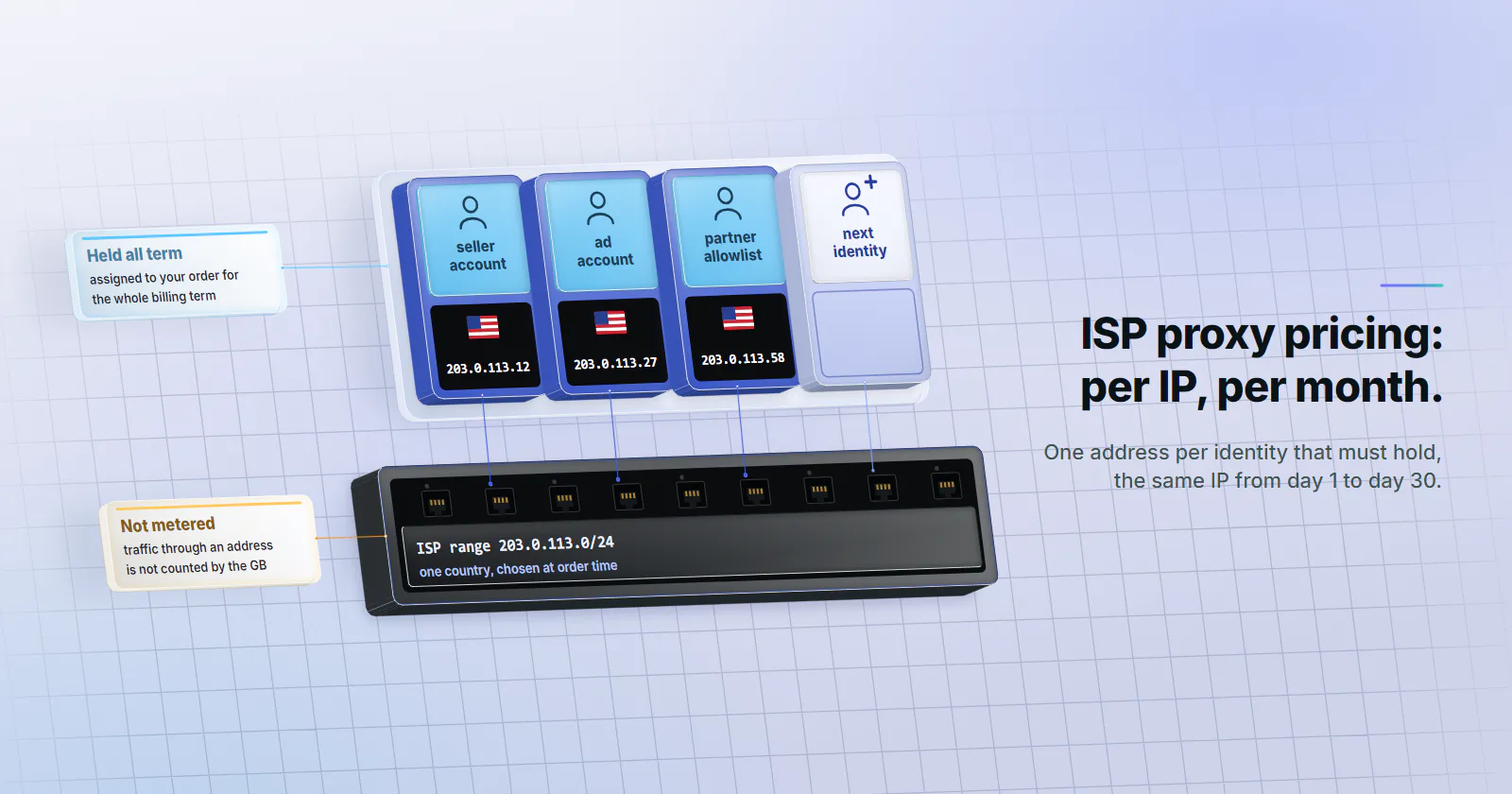
ISP proxy pricing is almost always per IP per month. A static ISP proxy is one ISP-registered address, assigned to your order for the whole billing term and not metered per GB, so the bill tracks how many addresses are held, not how much traffic moves. On proxymint, static ISP is billed per IP per month, and the per-IP rate falls as the order grows.
That answer is where most rate cards stop. The questions that decide the real bill sit one layer down: how many addresses the job needs, how a 3 or 12 month term is billed, and whether a static address is the right tier for the job at all.
ISP proxy pricing, in one answer
The unit is the address. A static ISP proxy is rented, not metered. The provider hands over one IP with its own username and password, and the customer keeps it for the month, the quarter or the year. Traffic through it does not move the price.
The rate falls with volume. Most providers publish a ladder: the more addresses in one order, the lower the per-IP rate. proxymint’s volume bands are on the pricing page. The monthly proxy pricing index tracks those ladders across providers, with sources.
The address is the product. There is no rotation. A seller dashboard, a partner allowlist or a long checkout flow sees the same IP on day 1 and day 30. If the job wants a new address per request, a rotating tier fits it instead, and how that tier is billed is covered in residential proxy pricing.
What sets the price of an ISP IP
A datacenter port and an ISP address are both a single IPv4 address, and both usually sit on servers in a datacenter, as ISP vs datacenter proxies explains. Three things set ISP proxy pricing at the level of the single address, and traffic is not one of them.
IPv4 is finite. The regional registries have no free pool left to hand out. ARIN’s free IPv4 pool was depleted on 24 September 2015 (ARIN, IPv4 depletion guide), and the RIPE NCC announced on 25 November 2019 that it had run out (RIPE NCC announcement). New addresses now come from transfers and waiting lists, which puts a floor under the cost of every IPv4 proxy.
ISP ranges are scarcer still. A hosting company can buy a large block and register it to its own network. An ISP proxy needs an address registered to an internet service provider’s network (its ASN), and fewer of those ranges are available for lease in any one country. That limits supply per country, and scarce supply sets the per-IP rate.
The trust is what is being paid for. Anti-bot vendors and marketplaces classify hosting ASNs on sight. An address in an ISP’s range starts from a different score. A lenient target does not check that difference, and a datacenter port serves the job there.
Are ISP proxies priced per IP or per GB?
Rate cards across the market mix several billing models, and the headline number means something different in each. Before comparing any two quotes, check which model sits behind it.
proxymint sells static ISP one way: dedicated, per IP, per month. A per-GB ISP quote and a per-IP quote are not comparable until the reader multiplies the first by the GB the job moves.
Shared vs dedicated ISP proxies
Shared. Several customers route through the same address. The cost is split, but the address carries everyone’s traffic. If one customer hammers a marketplace, the others inherit the flag.
Dedicated. One customer holds the address for the term, so no other customer’s traffic shares it during that term. For account work tied to one login location this is the version that makes sense; dedicated vs shared proxies covers the trade across tiers. proxymint’s static ISP proxies are assigned to your order for the whole billing term. No provider can promise what an address did before it was assigned, so the first test belongs inside the refund window.
What moves an ISP bill: terms and refunds
Three things set the monthly total, and one of them dominates.
The number of addresses. It is the bill. ISP proxy pricing per IP falls across volume bands as the order grows; the table on the pricing page lists the rate at every band, so price the exact quantity the job needs there. A team of 25 accounts that orders 25 addresses in one checkout pays one band rate on all of them. As a scenario, ten seller accounts make an order of 10 addresses, and that monthly bill stays the same whatever traffic the accounts move.
The term. Monthly plans renew monthly. A 3 or 12 month term is billed in full at the start, at the same monthly rate. A 12-month term suits addresses the team is certain to keep.
Refunds. The proxymint terms give per-IP products a full refund if returned inside 7 days, on a first purchase only and not on renewals. That window is the time to test whether the target accepts the addresses before committing a whole team to them.
What does not change the price
Several line items that raise the bill elsewhere are flat here. HTTP and SOCKS5 are both included on every IP, with no protocol picker and no upsell. Sites served over HTTPS still work: the client opens a tunnel through the HTTP proxy with the CONNECT method (RFC 9110, section 9.3.6, June 2022), so the proxy scheme stays http:// or socks5://. Login is username and password per IP. The country is chosen at order time from the countries with ISP ranges available, at one published rate, and it stays fixed for the life of the order. Traffic is not metered per GB, so a heavy month costs the same as a quiet one.
Cost per job, not per IP
The per-IP rate only means something next to the job.
| Job | Static ISP | Rotating residential | Datacenter IPv4 |
|---|---|---|---|
| 10 seller dashboards, one fixed login location each | Addresses hold all month | The address changes when a home device drops | Hosting ASN flagged by strict marketplaces |
| Price monitoring across thousands of pages | Not the job: an address is an identity, not a pipe | Fits broad collection, billed per GB | Works only if the target is lenient |
| API polling a lenient endpoint, heavy traffic | Fits if the endpoint expects an ISP-registered address | Metered per GB, so the bill follows the traffic | Flat per port, no bandwidth cap |
The requirement decides. An identity that must keep one address, every month, fits ISP whatever its traffic, and the bill stays flat on a heavy month. Light traffic that does not care about the address fits rotating residential proxies, billed per GB.
Jobs for the other tiers. Broad scraping that needs thousands of different IPs fits residential. Lenient bulk work fits datacenter proxies, billed per port per month. Targets that only trust a mobile origin need mobile proxies, a split covered in mobile vs ISP proxies. Static ISP is the right buy when an address has to hold.
How many ISP proxies to buy
A sizing method that avoids guessing:
- Count the identities that need a fixed login location: one per seller account, ad account, partner allowlist entry or long-running session.
- Decide how many parallel sessions each address carries. Strict targets tolerate one logged-in identity per address; a partner allowlist may accept one address for a whole team.
- Check the request rate. A static address is an identity, not a throughput pipe: keep each one at a steady rate a single user could produce. Bulk page collection is a different job, and rotating residential fits it.
- Add one or two addresses for testing, order a small set first, confirm inside the 7-day window that the target accepts the addresses, then scale.
For most account-management teams the number is one address per account, and often fewer addresses than they first expect. Keep a short list of which address serves which account, so a flagged address can be replaced without guessing which login it carried.
ISP proxy pricing by job
If the job needs the same address for weeks, logs into accounts tied to a location, or feeds a partner allowlist, ISP proxy pricing per IP matches that requirement: count the identities, price the exact quantity on the pricing page, and use the 7-day window to test. If the job needs many addresses or moves little traffic per identity, rotating residential per GB fits. If the target is lenient, datacenter ports fit.
Frequently asked questions
ISP proxies are usually priced per IP per month, and some providers sell them per GB or per day. The rate falls as the order grows. On proxymint static ISP is sold per IP per month in volume bands, with HTTP and SOCKS5 included, and every band is on the pricing page.
An ISP proxy is an IPv4 address registered to an internet service provider's network, and those ranges are scarcer than hosting blocks now that the regional registries have no free IPv4 pool left. Sites also score ISP ranges differently from hosting ranges, and that trust on strict targets is what the per-IP rate reflects.
Either, depending on the order. On proxymint a static ISP address can run month to month, renewing each month, or on a 3 or 12 month term that is billed in full at the start. The monthly rate is the same either way, and traffic is never metered per GB. Per-IP products get a full refund if returned inside 7 days, on a first purchase only and not on renewals.
Per-IP ISP plans are usually not metered per GB, but providers differ on fair-use limits and speed per IP, so the terms page is the place to check. proxymint does not meter ISP traffic per GB, so the monthly price stays the same on a heavy month and a quiet one.
On proxymint a 3 or 12 month ISP term is billed in full at the start at the same monthly rate. A long term suits addresses the team is certain to keep.
A shared ISP proxy routes several customers through the same address, which splits the cost but mixes everyone's traffic on that IP. A dedicated ISP proxy is assigned to one customer for the term, so no other customer's traffic runs through it during that term. proxymint assigns each static ISP address to your order for the whole billing term.
Count the identities that need a fixed login location, such as seller accounts, ad accounts or partner allowlist entries, and plan one address for each on strict targets. Add one or two for testing, and start with a small order inside the 7-day refund window.
Researched and drafted with AI tools, then checked against our publishing rules before it went live: 3 outside links, 10 links to other proxymint pages, no prices and a fact-check pass against our product records. How we write.