Mobile proxy pricing: what one carrier GB buys
Mobile proxy pricing explained: what a carrier GB buys, how to size a job before you pay, cost per successful request, and which jobs call for mobile IPs.
Quick summary · TL;DR
- Mobile proxies are usually sold per GB. On proxymint they come in one-off packages, the rate falls as the package grows, and the full table is on the pricing page.
- The rate reflects carrier supply and trust. Carriers share one public address across many subscribers with CGNAT, so platforms that score network origin treat carrier ranges carefully.
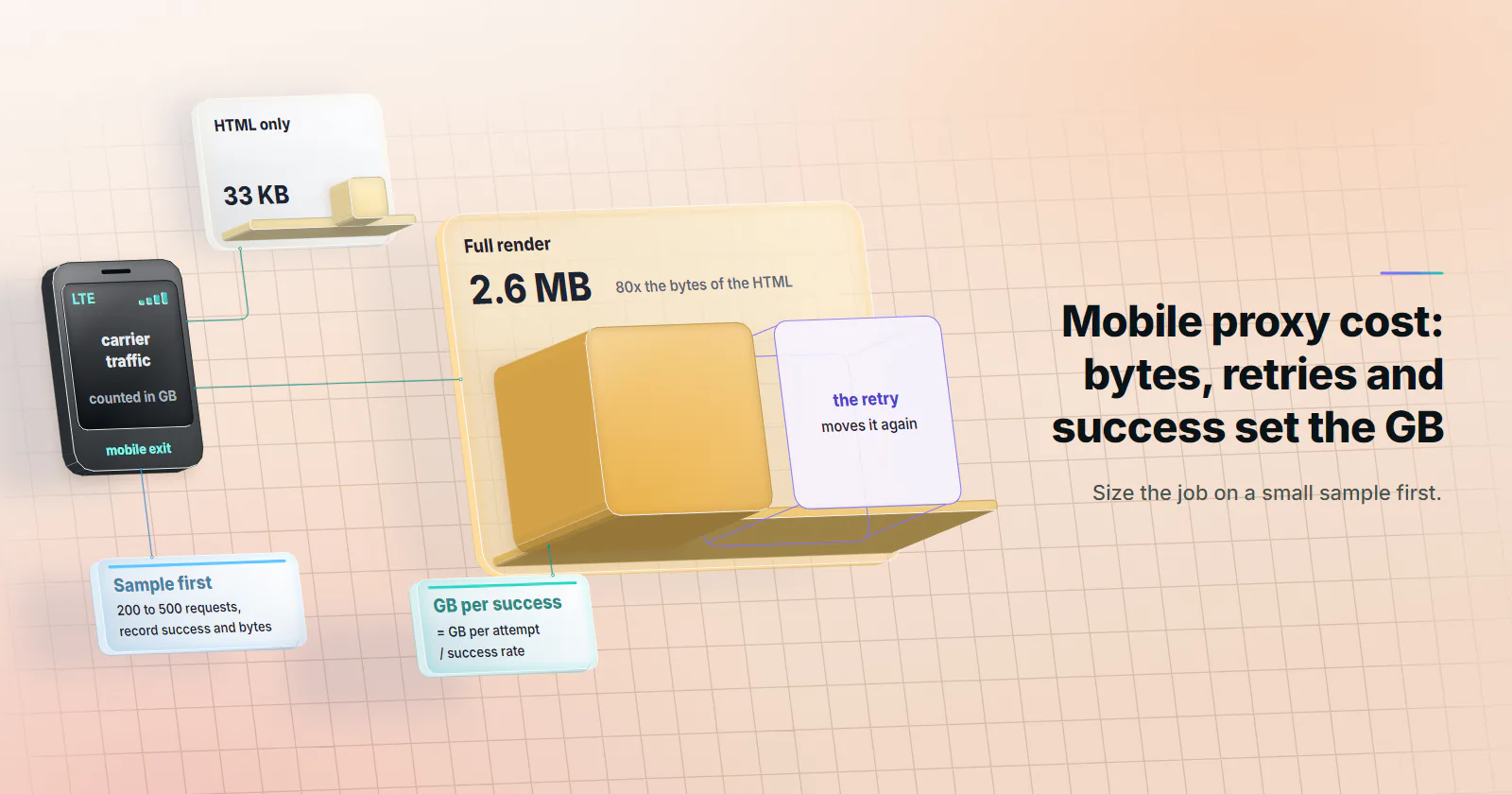
- Bytes drive the bill. A full mobile page render moves roughly 80 times the bytes of its HTML, and every retry is billed again.
- Measure cost per success. Success rate and bytes per attempt on the real target decide what a job actually costs.
- Match the tier to the target. Mobile fits app-first platforms, mobile ad checks and QA on carrier routing; catalogs and price checks usually clear on residential.
Mobile proxy pricing is usually per GB of traffic, and the rate falls as the package grows. On proxymint, mobile proxies are sold per GB as one-off packages with no renewal; every volume band is on the pricing page. The rate buys exits on mobile carrier networks, which mobile-first platforms, mobile ad checks and QA on carrier routing rely on.
Most pages that rank for this term are rate cards or provider roundups. They quote a price per GB and stop. A buyer’s real question comes one step later: how many GB does this job need, and does this target need a carrier IP?
How mobile proxy pricing works
The market sells mobile access by the GB, by the port per month, or by the day. Per GB is the most common unit on rate cards, and the per-GB rate steps down in volume bands as the package grows. How these units compare across every tier is covered in proxy pricing.
proxymint sells mobile per GB, and the rate per GB steps down with each larger package. Mobile proxy packages are one-off: the balance counts down as traffic moves, nothing renews or charges by itself, and proxymint does not set an expiry on GB.
What the rate includes. Country, region and city targeting from locations with devices online at order time. Rotation on every request, on a 5 to 60 minute timer, or sticky while the device stays online, changeable later on the same credentials. HTTP and SOCKS5, both included. Username and password authentication. No add-on charge applies to any of the above.
What sets the mobile per-GB rate
A mobile exit is a phone that reaches the internet through a mobile carrier network. A residential exit rides on a home broadband line. A datacenter exit is a rented address on a server. Mobile proxy cost reflects carrier supply.
Carrier data is the raw material. Every GB moved through a mobile exit travels over a carrier network, on a device that has to stay powered, connected and in the right city.
Supply is thin where buyers want it. Buyers ask for a country, then a region, then a city. The number of mobile devices online in one city at one moment is small next to a residential pool, and smaller still outside rich markets. The ITU Facts and Figures 2025 report (published October 15, 2025) puts 5G coverage at 55% of the world population, with 84% in high-income countries against 4% in low-income ones.
The trust is the product. Carriers put many subscribers behind one public IPv4 address with carrier-grade NAT, using the shared range set aside in RFC 6598 (April 2012). Cloudflare’s October 2025 CGNAT study says a single IPv4 address may stand for hundreds or even thousands of users. Blocking that address blocks real customers too, so platforms treat it carefully.
That trust shows on targets that score network origin. A catalog page that serves any home IP does not check whether the request came from a carrier.
Mobile proxy pricing models compared
Each model bills for something different, and each fits a different traffic shape.
Per GB fits uneven, spread-out work, the case for pay as you go proxies. A dedicated port fits one heavy, steady stream from one identity: thirty identities at once means thirty ports.
How to size a mobile proxy job
A per-GB bill is requests times bytes, plus the bytes that failed. Three numbers decide it.
Bytes per request. The HTTP Archive Web Almanac 2025 page weight chapter (published January 15, 2026) puts the median mobile home page at 2.6 MB and the median HTML document at 33 KB on mobile. A client that renders the full page moves about 80 times the bytes of one that fetches the HTML. That choice moves the bill more than any other setting.
Retries. A blocked or timed-out request still moves bytes, and the retry moves them again. A job with a 20% failure rate needs about a quarter more traffic than its clean request count suggests.
Hidden costs. Redirects, images and tracking scripts the client loads without being asked, and the headroom the order needs so the balance does not run out mid-job.
Take three jobs. App-first account work, where a team runs its own brand accounts from phones, is light: mostly API calls and small screens. A price-check job across four retail markets is heavy and repetitive, and usually fits residential (see below). App QA on carrier routing sits in between. As a scenario, a QA cycle that moves 20 GB fits one package of that size plus headroom for retries; the rate for that size, and any other, is on the pricing page.
Cost per successful request
A rate card quotes mobile proxy pricing per GB. What a job costs also depends on how many attempts succeed on the target.
The formula. GB per success = GB per attempt / success rate. On a per-GB bill, that figure is what a useful result costs.
Every failed attempt still moves bytes, so the success rate on the real target sets how many GB each useful result takes. On a target that scores network origin, that success rate is where carrier trust shows up in the numbers.
How the two tiers differ on targets that check the network origin, which is where a gap in success rates comes from, is covered in mobile vs residential proxies.
When mobile is more than the job needs
Mobile proxy pricing reflects a carrier origin, and mobile serves the targets that score one. For other jobs, another tier matches the requirement.
- Catalog and price monitoring. Retail catalog pages rarely check for a mobile origin. Rotating residential proxies clear most of them.
- Search result tracking, where the engine permits automated access. Residential covers city-level results.
- Lenient APIs, uptime checks and bulk collection. Datacenter proxies are billed per port per month with no per-GB meter.
- Heavy rendered throughput on targets that accept home or hosting IPs, where residential or datacenter carries the volume.
- One fixed address for weeks. Carrier IPs move by design; a static ISP address holds for the whole term, the split covered in mobile vs ISP proxies.
- Desk-based account work. A team that logs in from one office in a browser fits static ISP proxies. The platform’s own team or business access comes first either way.
- Speed tests of 5G itself. The generation changes throughput, not trust.
Mobile fits app-first account work the team runs itself, mobile ad verification in a market, app QA on carrier routing, and targets that expect a carrier origin.
Cheap mobile proxies
A very low per-GB price for “mobile” can mean real carrier exits sold at thin margin. It can also mean a residential or hosting pool with a mobile label. The check takes a few minutes on a small package:
- Look up the exit IP in an IP-intelligence database such as MaxMind. A mobile exit is classified as cellular, not as a fixed-line ISP or a hosting company.
- Check that the IP geolocates to the market ordered.
- Rotate a few times and repeat the lookup. Each exit should come back as cellular; the operator can change between rotations.
Cheap mobile proxies that fail step 1 are residential or datacenter traffic under a mobile label, and that tier bought as such does the same job.
Test before a big package
A small package settles the question on the reader’s own target:
- Two small packages. Buy a small mobile package and a small residential package, one checkout each.
- A representative sample. Pick 200 to 500 requests that represent the job, on pages the target’s terms allow.
- Identical runs. Run them through both tiers with the same client, headers and rotation mode.
- Success and bytes. Record the success rate and the bytes per success from the usage counter.
- Order size. Plug both into the GB-per-success formula, then size the real order from the bytes per success.
Frequently asked questions
Mobile proxies are usually priced per GB of traffic, with the rate falling as volume grows. On proxymint they are sold in one-off packages with no renewal, and every volume band is on the pricing page. Some providers also sell a monthly port or a day pass with unmetered data instead.
A mobile exit is a phone that reaches the internet through a mobile carrier network, and supply per city is thin. Carriers often share one public address across many subscribers with carrier-grade NAT, so platforms treat carrier ranges carefully. That trust is what the per-GB rate reflects.
They are worth it when the target scores a mobile origin: app-first platforms, mobile ad verification and QA on carrier routing. For catalogs, price checks and most public pages, residential or datacenter usually clears the same target. A small test on both tiers settles it.
Per GB fits uneven work spread across many IPs, because unused traffic stays on the balance. A monthly port with unmetered data fits one heavy, steady stream, but idle ports are paid for anyway, and one port is one identity at a time. proxymint sells mobile per GB only.
Multiply the number of requests by the bytes per request, then add headroom for retries. The 2025 Web Almanac puts the median mobile home page at 2.6 MB and its HTML at 33 KB, so rendering pages instead of fetching HTML changes the order size by a factor of about 80. A 200 to 500 request sample gives the real figure.
Some are, and some are residential or hosting addresses with a mobile label. Look up the exit IP in an IP-intelligence database such as MaxMind: a mobile exit is classified as cellular and geolocates to the market ordered. If it comes back as a fixed-line or hosting network, it is not carrier traffic, and a residential or datacenter tier bought as such does the same job.
On proxymint, targeting, rotation mode and both HTTP and SOCKS5 are included in the per-GB rate with no add-on charge, and nothing renews. At other providers, check for paid add-ons such as city targeting or a dedicated port.
Researched and drafted with AI tools, then checked against our publishing rules before it went live: 4 outside links, 9 links to other proxymint pages, no prices and a fact-check pass against our product records. How we write.